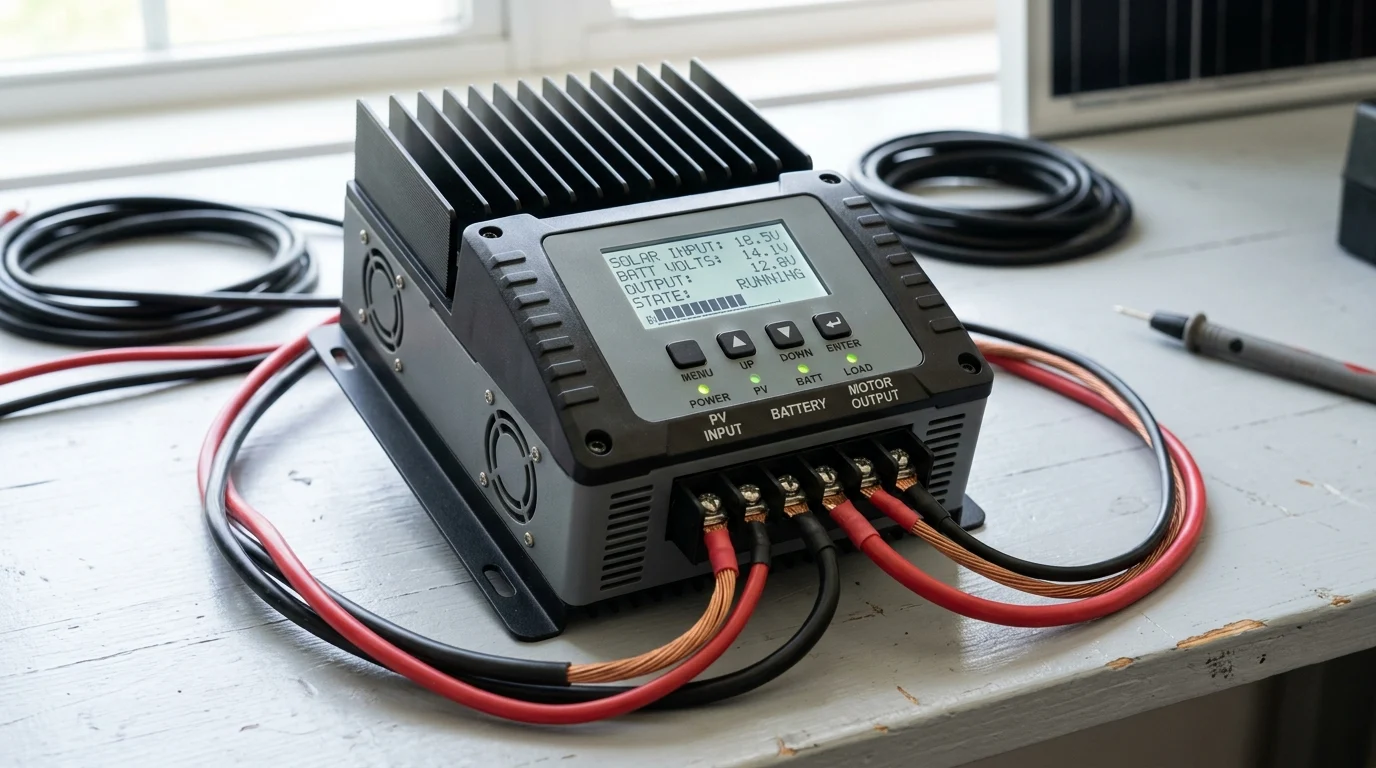
Why MPPT Is a Core Buying Criterion
In the rapidly expanding market for off-grid and hybrid industrial applications, the solar motor controller serves as the critical bridge between photovoltaic arrays and motor-driven loads. For B2B procurement teams, wholesale distributors, and original equipment manufacturers (OEMs), the integration of Maximum Power Point Tracking (MPPT) technology has transitioned from a premium feature to a mandatory baseline. Unlike legacy architectures, modern MPPT algorithms dynamically adjust the electrical operating point of the solar array, ensuring maximum power extraction regardless of fluctuating irradiance or temperature.
Selecting the right MPPT solar motor controller directly impacts the commercial viability of end products such as solar industrial fans, solar water pumps, and solar air compressors. Buyers must evaluate these components not just on theoretical efficiency, but on their ability to integrate seamlessly with specific motor profiles, such as frameless Brushless DC (BLDC) motors, while maintaining strict cost controls and meeting minimum order quantity (MOQ) thresholds.
Energy Yield and Motor Uptime
The primary commercial advantage of MPPT technology lies in its ability to significantly increase energy yield, directly translating to extended motor uptime. By decoupling the solar panel voltage from the motor’s operating voltage, MPPT controllers can harvest 15% to 30% more energy compared to traditional Pulse Width Modulation (PWM) systems. This is particularly crucial during early morning, late afternoon, or overcast conditions.
For industrial applications requiring continuous operation, this extended uptime is a major selling point. A solar water pump or ventilation fan equipped with a high-efficiency MPPT controller can operate effectively for up to 2 to 3 additional hours per day. This operational resilience reduces the reliance on battery storage or grid backup, thereby lowering the total cost of ownership for the end-user and enhancing the value proposition for distributors.
Daytime Load Matching
Modern solar motor controllers must manage highly variable daytime loads. An MPPT system excels at dynamic load matching, continuously recalculating the optimal voltage-to-current ratio to sustain motor operation without stalling. This is vital when pairing controllers with specialized motor components.
When driving motors that operate within a 200W to 1000W power band and speeds ranging from 500 to 6000 RPM, the controller must instantly adapt (typically within 10 to 50 milliseconds) to sudden torque demands. MPPT algorithms prevent voltage collapse under heavy loads, ensuring that industrial fans or air coolers maintain optimal RPMs even when passing clouds momentarily drop solar irradiance by 40% or more.
Distributor Demand for MPPT Platforms
From a channel perspective, wholesale distributors are increasingly demanding MPPT-enabled platforms due to shifting market expectations and improved profit margins. End-users in agricultural and industrial sectors now expect intelligent photovoltaic microgrid solutions that offer day/night energy support and photoelectric complementarity. Distributors supplying these markets cannot afford to carry obsolete PWM inventory.
Furthermore, standardizing on MPPT platforms simplifies SKU management. A single, highly adaptable MPPT controller can often service a wider range of solar panel configurations and motor types, reducing the need to stock dozens of micro-segmented variants. Suppliers typically offer these advanced controllers with MOQs ranging from 100 to 500 units and typical production lead times of 4 to 6 weeks for custom-branded or firmware-tailored batches, allowing distributors to scale their purchasing in alignment with project demands.
How MPPT Improves Solar Motor Controller Performance

Understanding the technical mechanics of MPPT is essential for procurement engineers tasked with vetting supplier specifications. The performance of a solar motor controller is dictated by the speed and accuracy of its tracking algorithm, the thermal resilience of its power electronics, and its compatibility with advanced motor control methodologies like Field Oriented Control (FOC).
Evaluating these controllers requires looking past marketing claims and drilling down into the granular electrical parameters that dictate field reliability and energy conversion efficiency.
Key Electrical Specifications to Compare
When comparing MPPT controllers, buyers must scrutinize several core electrical specifications. The Maximum Open Circuit Voltage (Voc) determines how many solar panels can be wired in series, directly impacting installation costs. A robust industrial controller should typically support a Voc of at least 150V to 450V DC, depending on the target application.
Equally important are the efficiency metrics and thermal limits. Procurement teams should mandate a minimum MPPT tracking efficiency of 99%, a peak power conversion efficiency of 97% to 98%, and wide operating temperature ranges (typically -20°C to +60°C without derating). Additionally, the controller must feature robust motor drive specifications, including sensorless FOC capability, which ensures smooth startup and high torque at low speeds for BLDC motors. Over-current, over-voltage, and dry-run protection thresholds must also be explicitly defined in the supplier’s technical datasheet.
MPPT vs Non-MPPT Controllers
The technical divergence between MPPT and non-MPPT (PWM) controllers is stark. A PWM controller essentially forces the solar array to operate at the voltage of the battery or motor load, dragging down the panel’s operating voltage and discarding valuable power. In a 24V system, a panel capable of outputting 36V is artificially capped, resulting in severe energy losses.
Conversely, an MPPT controller utilizes a high-frequency DC-DC converter to transform the high voltage/low current output of the solar array into the exact voltage/current ratio required by the load. This decoupling allows the solar panels to operate continuously at their Maximum Power Point (Vmp), while the motor receives the precise power profile needed to maintain its RPM, regardless of the panel’s fluctuating output.
Comparison Tables Buyers Should Request
To facilitate objective vendor selection, procurement teams should request standardized comparison tables from potential suppliers. These tables should map the performance of the supplier’s MPPT controllers against both legacy PWM models and competing MPPT solutions.
| Specification / Feature | Premium MPPT Controller | Legacy PWM Controller | Impact on B2B Application |
|---|---|---|---|
| Tracking Efficiency | > 99.5% | N/A | Maximizes energy harvest in low-light conditions. |
| Power Conversion Efficiency | 97% – 98% | 75% – 85% | Reduces thermal output; allows for smaller heatsinks. |
| Input Voltage Range (Voc) | Wide (e.g., 60V – 400V DC) | Narrow (Matched to load) | Enables flexible panel wiring and longer series strings. |
| Motor Control Strategy | Sensorless FOC | Trapezoidal / Square Wave | Quieter operation, higher torque, reduced mechanical wear. |
| Typical Cost Band (Wholesale) | $45 – $150+ | $15 – $40 | Higher upfront cost offset by 20%+ system efficiency gains. |
What Procurement Teams Should Verify
Strategic sourcing of solar motor controllers requires rigorous vendor qualification. Procurement teams must look beyond the initial price quote to evaluate the supplier’s engineering depth, manufacturing quality control, and ability to support complex integration requirements.
A comprehensive vetting process minimizes downstream risks, ensures compatibility with proprietary motor designs, and guarantees that the controllers will perform reliably in harsh commercial environments.
Core Product Definition Checks
The first step in vendor qualification is a deep dive into the core product definition. Buyers must verify the bill of materials (BOM), specifically the origin and rating of critical components like MOSFETs, DSPs (Digital Signal Processors), and electrolytic capacitors (e.g., capacitors rated for 10,000+ hours at 105°C). High-grade components from Tier-1 semiconductor brands are non-negotiable for controllers expected to achieve a 5-to-10-year operational lifespan.
Thermal management and environmental protection are equally critical. Procurement teams should verify the physical dimensions and thermal dissipation capacity of the extruded aluminum heatsinks. For outdoor or industrial applications, the controller enclosure must meet strict ingress protection standards, typically IP65 or IP67, to defend against dust, moisture, and corrosive environments. Buyers should request thermal imaging reports showing component temperatures under full load.
Supplier Firmware and Customization Capability
Hardware alone does not define a modern solar motor controller; firmware is the true differentiator. Suppliers must demonstrate the capability to customize MPPT algorithms and motor control parameters to match the buyer’s specific hardware. For example, if integrating a frameless BLDC motor component with a 76.4mm outer diameter and a 44.6mm inner diameter, the firmware must be tuned to its exact inductance and resistance values to optimize FOC performance.
Furthermore, B2B buyers should prioritize suppliers offering advanced communication protocols. Controllers equipped with RS485, Modbus, or CAN bus interfaces allow for seamless integration into broader intelligent photovoltaic microgrid solutions. The ability to push Over-The-Air (OTA) firmware updates via connected IoT gateways is increasingly critical for remote diagnostics and performance tuning.
Pre-Order Qualification Steps
Before placing bulk orders, procurement teams must execute a structured pre-order qualification protocol. This begins with purchasing an engineering sample batch (typically 2 to 5 units) for rigorous bench testing and field trials. Engineers must validate the MPPT tracking speed under simulated shading conditions and verify the motor’s starting torque.
Simultaneously, procurement should conduct a factory audit—either physical or via a certified third party—to assess the supplier’s quality management system (e.g., ISO 9001). Key metrics to establish during this phase include the supplier’s historical defect rate (which should strictly remain below 0.5%), their burn-in testing procedures (e.g., 100% full-load testing for 24 to 48 hours), and their capacity to scale production without compromising quality.
Which Compliance and Logistics Factors Matter
Successfully importing and distributing solar motor controllers involves navigating a complex web of international compliance standards and supply chain logistics. A product with excellent technical specifications can still become a liability if it fails at customs or arrives damaged due to substandard packaging.
B2B buyers must align with suppliers who understand the regulatory landscapes of target markets and who implement robust logistics and after-sales support frameworks to protect distributor margins.
Required Certifications and Documents
Electronic controllers integrated into solar power systems are subject to stringent regional certifications. For the European market, CE marking is mandatory, requiring compliance with directives such as EN 62109 (Safety of power converters for use in photovoltaic power systems) and the RoHS directive regarding hazardous substances. In North America, UL 1741 certification is often required for grid-interactive and standalone inverters and controllers.
Procurement teams must demand verifiable test reports from accredited third-party laboratories (e.g., TÜV, SGS, or Intertek) rather than relying solely on supplier declarations. Discrepancies in certification documents can lead to shipments being seized at customs, resulting in severe supply chain disruptions and financial penalties.
Packaging, Labeling, and Spare-Parts Policy
Industrial electronics require specialized packaging to survive global transit. Controllers must be shipped in anti-static bagging and seated in custom-molded EPE foam to prevent shock damage. Procurement should stipulate that master cartons pass ISTA 1A drop testing. Clear labeling, including scannable barcodes, serial numbers, and precise electrical ratings, is essential for efficient warehouse intake and warranty tracking.
A well-defined spare-parts policy is a cornerstone of B2B risk management. Given the high cost of international RMA (Return Merchandise Authorization) shipping, leading suppliers typically provision 1% to 2% of total order volume as spare PCB boards or complete replacement units. This allows distributors to handle warranty claims locally, ensuring immediate resolution for end-users.
Channel and Margin Considerations
Profitability in the distribution channel relies on accurate landed-cost calculations. Buyers must factor in freight, insurance, and import duties. Solar motor controllers generally fall under HS code 8504.40 (Static converters), but tariffs can vary wildly depending on the country of origin and current trade agreements. Freight alone can add 5% to 12% to the landed cost depending on volumetric weight. Procurement must monitor these variables to maintain target wholesale gross margins, which typically range from 25% to 40%.
Furthermore, buyers should negotiate volume rebate tiers and territorial exclusivity agreements. Securing exclusive distribution rights for a specific region protects the distributor’s investment in marketing and channel development, preventing a race to the bottom on pricing for identical hardware.
How to Select the Right MPPT Solar Motor Controller

The final selection of an MPPT solar motor controller supplier requires synthesizing technical data, cost analysis, and supply chain reliability into a cohesive procurement strategy. Buyers must weigh the immediate capital expenditure against long-term operational stability and the vendor’s capacity for innovation.
Key Takeaways
- Wholesale sourcing and supply-chain implications for Solar Motor Controller
- Specifications, compliance, and commercial terms buyers should validate
- Actionable recommendations for distributors and procurement teams
Frequently Asked Questions
Why is MPPT essential in a solar motor controller?
MPPT extracts the panel’s best power point in changing sun and temperature, typically delivering 15%–30% more usable energy than PWM and extending motor runtime.
How much longer can an MPPT controller keep pumps or fans running?
In many installations, MPPT can add about 2–3 hours of daily operation during weak sun, reducing dependence on batteries or grid backup.
What specs should buyers check first in an MPPT solar motor controller?
Start with PV open-circuit voltage range, controller efficiency, response speed, motor compatibility, and thermal protection. For industrial use, higher Voc support improves array design flexibility.
Can MPPT controllers work with Eternal Energy’s microgrid applications?
Yes. MPPT fits solar water pumps, industrial fans, air coolers, and air compressors, and supports smarter energy use in photoelectric complementarity and day/night microgrid systems.
How does MPPT help BLDC motors under changing load conditions?
It quickly adjusts voltage and current to match torque demand, helping 200–1000W BLDC systems avoid stalling and maintain steadier RPM when irradiance suddenly drops.