Brushless Direct Current (BLDC) motors are revolutionizing renewable energy systems by providing unmatched operational efficiency and system reliability. When integrated with solar photovoltaic networks, these advanced motor drives maximize power utilization while significantly minimizing energy dissipation. This comprehensive guide evaluates how modern solar power infrastructures utilize high-performance BLDC motor design to achieve optimal fluid management, solar tracking, and decentralized mechanical actuation.
The Operational Mechanics of Solar-Powered BLDC Motor Drives
A solar-powered BLDC motor system utilizes synchronous permanent magnet rotors and electronic commutation to convert direct current from photovoltaic panels into mechanical motion without mechanical friction. Unlike traditional alternating current (AC) induction motors, a brushless motor eliminates brushes, reducing internal thermal losses and eliminating mechanical wear components. This physical configuration ensures that the propulsion system adapts instantly to fluctuating solar irradiance levels, maintaining high torque even during low-light operations.
In a standard standalone solar water pumping system, the direct current generated by a solar array passes through a dedicated power electronic controller before driving the motor. This integration eliminates the requirement for bulky, inefficient power inverters, creating a streamlined, low-loss electrical architecture. Recent research published in the Journal of Renewable Energies (2026) demonstrates that integrating BLDC pumps enhances system efficiency, reliability, and energy savings while adapting effectively to variable solar input. By optimizing the electrical layout, engineers can reduce total component costs while expanding the operational lifespan of off-grid mechanical installations.
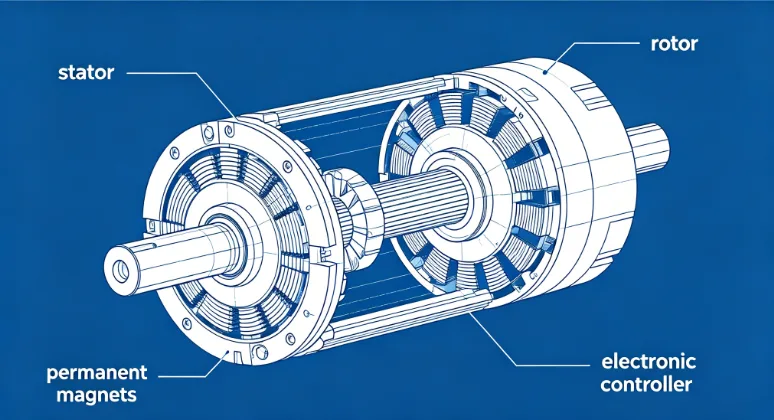
To help system engineers evaluate different electric motor topologies for green energy applications, the following comparative analysis highlights the key performance metrics of available motor technologies:
| Performance Metric | Brushed DC Motors | AC Induction Motors | High-Efficiency BLDC Motors |
|---|---|---|---|
| Average Operational Efficiency | 75% – 80% | 80% – 85% | 89% – 93% |
| Maintenance Requirements | High (Periodic brush replacement) | Low (Bearing wear only) | Exceptionally Low (No wearing contacts) |
| Low-Light Start Threshold | High Voltage Required | High Starting Torque Required | Minimal Starting Current (Advanced Commutation) |
| System Complexity | Low | High (Requires variable frequency drive) | Medium (Integrated electronic controllers) |
| Lifespan Expectancy | Short (2,000 – 5,000 hours) | Long (15,000 – 20,000 hours) | Extremely Long (>30,000 hours) |
Maximum Power Point Tracking Optimization in Brushless Systems
Maximum Power Point Tracking (MPPT) algorithms operate as the critical computational link between dynamic solar panels and high-torque brushless dc motor components. Because solar irradiance shifts throughout the day, the electrical output of a photovoltaic array is inherently non-linear, requiring constant impedance matching. Advanced MPPT controllers modulate the duty cycle of DC-DC converters, ensuring the solar array constantly operates at its peak wattage output.
When an efficient MPPT controller pairs with a permanent magnet brushless motor, the entire renewable energy system experiences a massive compounding efficiency boost. According to an industry roadmap by Efficiency for Access, wire-to-water efficiency serves as the benchmark metric for modern solar water pump technology, directly dictating total solar panel requirements. A high-efficiency BLDC motor allows the MPPT system to extract maximum fluid output even when ambient solar radiation falls below 300 Watts per square meter. This capability ensures that agricultural irrigation networks and remote community water supplies function reliably during early morning and late afternoon hours.
Comparative Analysis: BLDC Motors versus AC Induction Counterparts
Industrial field tests confirm that permanent magnet BLDC motors deliver up to 20% more mechanical output than standard AC induction motors under identical solar array configurations. The primary driver behind this disparity is the absence of rotor copper losses within the brushless architectural framework. While induction motors require substantial electrical energy to magnetize the rotor windings, BLDC motors utilize high-coercivity Neodymium (NdFeB) permanent magnets to establish a permanent magnetic field.
Technical documentation regarding an Efficient 5-HP BLDC Solar Pump Design indicates that within a speed range of 1200 to 2900 RPM, brushless motor efficiency remains between 89% and 92%. Conversely, standard AC induction motor efficiency drops precipitously to between 74% and 82.5% when operating under reduced speeds. This wide-range efficiency profile makes the brushless motor an ideal asset for dynamic solar installations. System integrators looking for dependable components can source high-caliber machinery from an established bldc motor manufacturer to guarantee robust thermal management and optimized coil winding configurations.
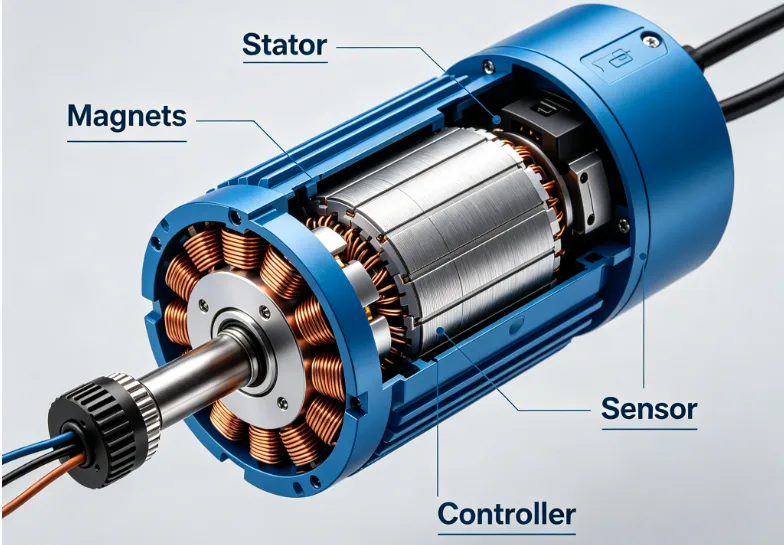
To systematically select the appropriate propulsion architecture for large-scale solar projects, engineers should consult the following component selection checklist:
- Verify Solar Voltage Compatibility: Ensure the operational voltage of the motor controller matches the open-circuit voltage (Voc) of the photovoltaic array.
- Evaluate Thermal Dissipation Ratings: Choose motors equipped with IP65 or IP68 ingress protection to withstand extreme desert or agricultural environments.
- Assess Starting Torque Requirements: Confirm that the integrated sensorless control algorithm can initiate rotor movement under full hydraulic head load.
- Audit Electronic Protection Suites: Select drive units that incorporate integrated over-voltage, dry-run, and thermal overload safety shutoffs.
Advanced Solar Tracking Mechanisms Driven by Brushless Actuators
Dual-axis solar tracking arrays rely heavily on precise, low-power brushless motor actuators to continuously align photovoltaic modules with shifting solar vectors. By maintaining a perpendicular angle to the sun’s rays, tracking arrays can boost total daily energy capture by up to 40% compared to fixed-tilt structures. Because these tracking mechanisms operate continuously in exposed outdoor environments, the drive motors must withstand intense wind loads and extreme temperature swings.
Implementing high-torque brushless actuators ensures precise micro-positioning without the risk of gear wear or positional backlash typical in older brushed systems. The digital nature of electronic commutation allows for seamless integration with microcontrollers running astronomical almanac algorithms or real-time optical sensor loops. For custom commercial configurations, sourcing specialized parts from a dedicated bldc motor factory ensures precise compliance with precise torque specifications and mechanical mounting tolerances. Furthermore, utilizing high-quality wholesale bldc motor channels allows developers to deploy large-scale tracking fields while keeping capital expenditures within strict budgetary guidelines.
Decoupled System Architecture and Off-Grid Reliability Standard
Decoupled off-grid solar architectures using intelligent brushless motor controller units achieve superior resilience by eliminating centralized points of mechanical failure. In remote regions where utility grid infrastructure is non-existent, equipment downtime can lead to catastrophic agricultural or humanitarian outcomes. The solid-state electronic commutation of a brushless system eliminates carbon dust accumulation, reducing the risk of internal electrical shorts and extending service intervals beyond five years.
To understand the full financial and operational benefits of transitioning to brushless solar architectures, developers can analyze the comprehensive breakdown below:
- Minimized Maintenance Costs: Eliminating physical carbon brushes removes the primary wear component, reducing field service interventions to near zero.
- Reduced Solar Panel Capital Expenditure: The 92% motor efficiency allows engineers to minimize total photovoltaic surface area, lowering structural framing expenses.
- Enhanced System Adaptability: Smart controllers allow for direct integration with external IoT telemetry modules for real-time remote performance monitoring.
For procurement managers managing expansive clean energy portfolios, establishing direct partnerships with an OEM bldc motor supplier streamlines long-term supply chains. Accessing specialized custom bldc motor engineering services ensures that specific shaft dimensions, flange types, and specialized winding resistances match the unique environmental demands of the project.
Frequently Asked Questions (FAQ)
1. Why are BLDC motors more efficient than AC induction motors in solar applications?
BLDC motors achieve higher efficiency because their rotors utilize permanent magnets rather than copper windings, eliminating rotor electrical losses entirely. According to engineering field data, a brushless motor maintains an efficiency rating above 89% across variable operating speeds, whereas an AC induction motor drops to 74% under fluctuating solar inputs.
2. Can a solar-powered BLDC motor operate directly from photovoltaic panels without a battery?
Yes, a solar-powered BLDC motor can operate directly from a photovoltaic array when paired with a specialized controller containing an integrated MPPT algorithm. The electronic controller continuously adjusts the motor speed and torque to match the real-time electrical output of the solar panels, eliminating the need for expensive battery storage banks.
3. What maintenance is required for an off-grid solar BLDC motor system?
An off-grid solar BLDC motor system requires minimal maintenance because it contains no physical brushes that wear down or generate carbon dust over time. Operational upkeep is generally limited to periodic cleaning of the solar panel arrays to prevent shading losses and inspecting structural seals and mechanical bearings every few years.
4. How do environmental temperature fluctuations affect solar-powered brushless motors?
Elevated environmental temperatures reduce solar panel voltage output and increase internal resistance within motor windings, which can slightly lower overall system performance. High-quality brushless motors mitigate this issue by utilizing premium Neodymium magnets with high thermal coercivity ratings and integrating automated thermal throttling within the electronic drive controller.
5. What are the primary selection criteria when sourcing wholesale BLDC motors for solar tracking?
Procurement teams should prioritize total torque output, continuous current ratings, ingress protection certifications (IP65 or higher), and electronic controller compatibility when sourcing wholesale components. Partnering with a specialized factory allows for custom modifications to shaft configurations and winding resistances, ensuring optimal integration with specific planetary gearboxes and structural mounts.