Quick Answer:
Solar industrial fans solve 24/7 factory ventilation challenges by combining photovoltaic direct-drive motor technology with intelligent energy management systems. These systems operate independently of the power grid, providing continuous air circulation during production hours while reducing energy costs by up to 80% compared to traditional electric ventilation. Modern solar industrial fans feature hybrid configurations that integrate battery storage and grid backup, ensuring uninterrupted operation during nighttime hours and low-light conditions. The technology addresses the core industrial ventilation requirements of temperature reduction, humidity control, and air quality maintenance across large warehouse, manufacturing, and processing facilities.
Key Takeaways:
- Solar industrial fans eliminate grid dependency while providing continuous 24/7 ventilation through hybrid energy management
- Temperature reduction of 8-12°C in factory workshops significantly improves worker productivity and comfort
- Photovoltaic direct-drive technology removes transmission losses, achieving 95%+ motor efficiency
- Total cost of ownership analysis shows ROI within 3-5 years for medium to large facilities
- System selection depends on facility size, ceiling height, geographic location, and specific ventilation requirements
Understanding the 24/7 Ventilation Challenge in Modern Factories
Factory workshops present unique ventilation challenges that differ fundamentally from commercial buildings or residential spaces. Manufacturing environments generate continuous heat loads from machinery, chemical processes, and human occupation, creating persistent demands for air circulation that extend far beyond typical business operating hours. According to the U.S. Department of Energy’s industrial energy efficiency research, manufacturing facilities consume approximately 25% of total industrial energy for HVAC and ventilation systems, representing a significant operational cost that directly impacts production economics.
The 24/7 ventilation requirement stems from multiple operational realities in modern industrial settings. Continuous production lines in automotive manufacturing, food processing plants, and electronics assembly facilities cannot tolerate temperature fluctuations that affect product quality or equipment performance. Warehouses storing temperature-sensitive materials such as pharmaceuticals, chemicals, or agricultural products require constant environmental control to prevent spoilage and maintain regulatory compliance. Additionally, occupational health regulations in most jurisdictions mandate minimum ventilation rates regardless of production schedules, meaning facilities must maintain air exchange even during off-hours maintenance periods.
Traditional ventilation approaches relying on electric fan systems create substantial operational burdens. Grid-dependent systems incur ongoing electricity costs that compound over facility lifespan, typically representing 15-30% of total facility energy expenses for heavily automated plants. Power interruptions—whether from grid failures, planned outages, or voltage fluctuations—create ventilation gaps that risk product damage, equipment overheating, and worker safety violations. The complexity of electrical infrastructure, including motor controllers, ductwork, and distribution panels, generates maintenance requirements that divert technical resources from core production activities.
How Solar Industrial Fan Technology Works
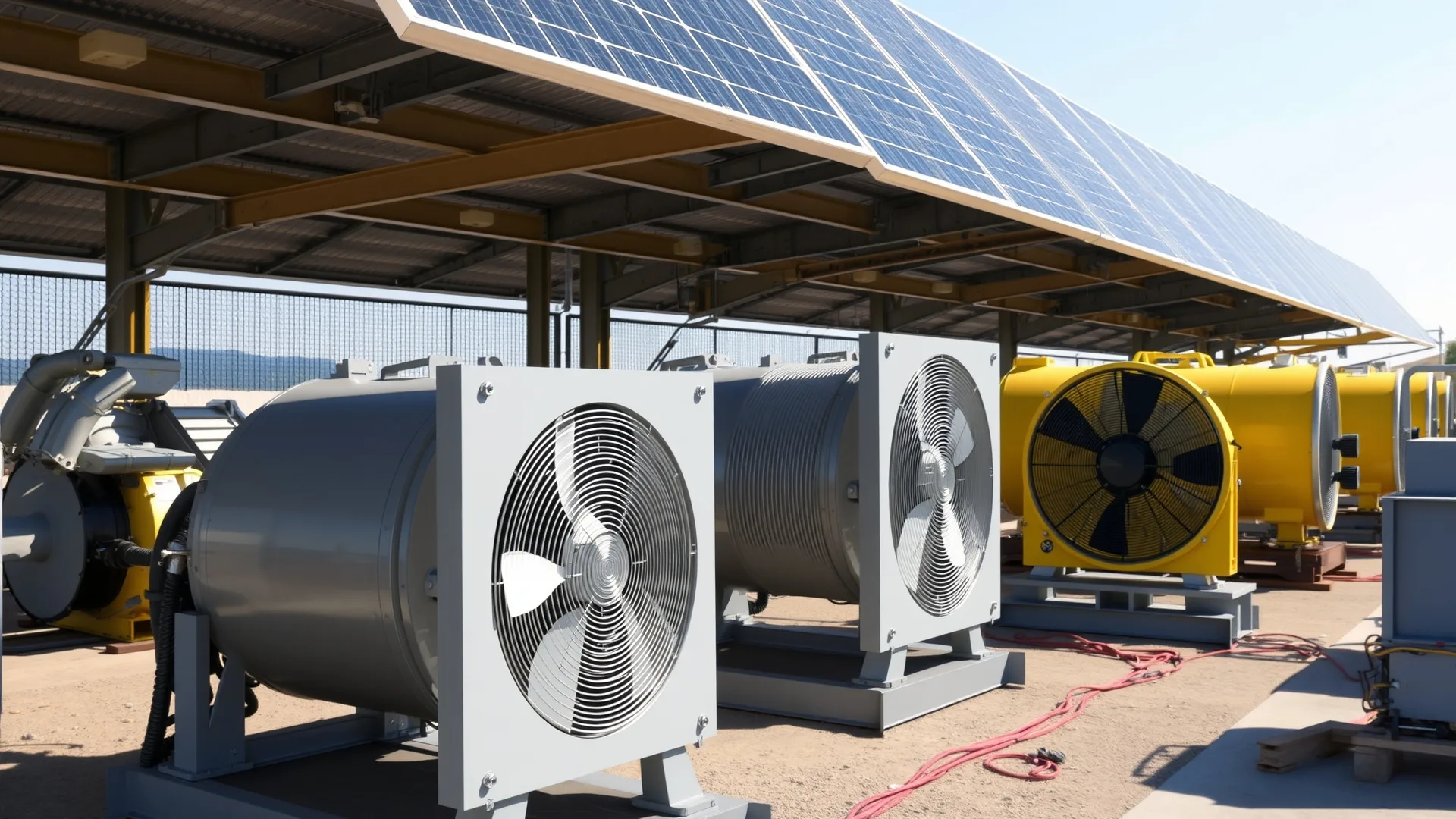
Solar industrial fans represent a fundamental departure from conventional ventilation technology through their direct conversion of solar energy into mechanical air movement. The core innovation lies in photovoltaic direct-drive motor systems that eliminate intermediate energy conversion stages present in traditional AC motor designs. When sunlight strikes the solar panel array mounted on facility rooftops or adjacent structures, photons release electrons that generate direct current electricity. This electricity flows through minimal power conditioning equipment to brushless DC motors specifically engineered for solar operation, where electromagnetic forces directly produce rotational motion for fan impellers.
The technical architecture of modern solar industrial ventilation systems comprises four integrated subsystems working in coordination. The solar collection subsystem includes high-efficiency monocrystalline or polycrystalline photovoltaic modules with typical ratings of 400-500 watts per panel. Array sizing calculations consider geographic location, available mounting area, seasonal solar availability, and required ventilation volume to determine optimal panel count and orientation. The power conversion subsystem manages maximum power point tracking (MPPT) to optimize energy extraction across varying irradiance conditions, ensuring consistent motor performance throughout the day.
The motor and fan assembly subsystem represents the critical efficiency link in solar ventilation systems. Direct-drive brushless DC motors achieve efficiency ratings exceeding 95%, compared to 85-90% for conventional AC induction motors with belt drive transmissions. This efficiency advantage translates directly to reduced solar panel requirements and smaller footprint installations. Fan impeller design follows industrial standards for high-volume, low-pressure applications, with axial flow configurations dominating for general ventilation while centrifugal designs serve high static pressure requirements in ducted systems.
The energy management subsystem distinguishes premium solar ventilation solutions from basic solar fan implementations. Advanced systems incorporate lithium-ion or lithium iron phosphate battery storage with capacities scaled to expected nighttime and low-irradiance operation duration. Intelligent controllers monitor energy flows, battery state-of-charge, and facility ventilation requirements to optimize operating modes. Grid integration capabilities in hybrid configurations provide backup power input when solar generation and battery reserves prove insufficient, ensuring uninterrupted ventilation regardless of external conditions.
Achieving Continuous 24/7 Operation: Technical Solutions
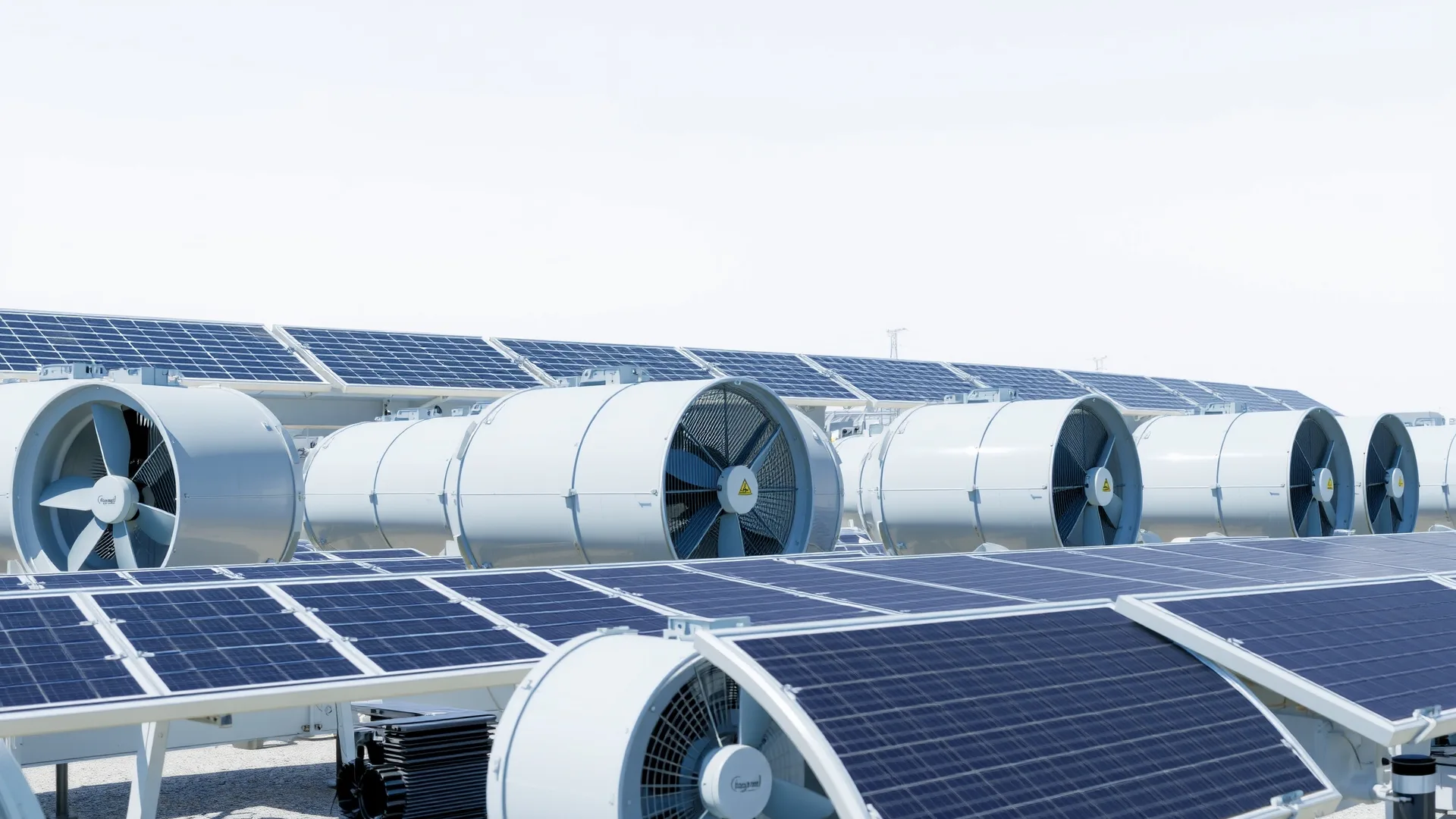
True 24/7 ventilation capability requires addressing the fundamental challenge of solar energy availability: zero generation during nighttime hours and reduced output during cloudy periods. Modern solar industrial fan systems resolve this limitation through three complementary technical approaches that facilities can implement individually or in combination based on operational requirements and budget constraints.
Battery storage integration provides the most straightforward solution for nighttime ventilation continuity. Lithium-based battery banks sized to meet expected nighttime ventilation loads store excess solar generation during peak production hours for deployment after sunset. System designers calculate required storage capacity by analyzing facility ventilation requirements during non-sunlight hours, typically spanning 10-14 hours depending on geographic latitude and seasonal variations. Battery management systems prevent over-discharge and over-charge conditions while maximizing cycle life, with quality installations offering 10+ year operational lifespans for storage components.
Hybrid configurations combining solar power with grid or generator backup represent the comprehensive solution for mission-critical applications. These systems automatically transition to alternative power sources when battery reserves fall below critical thresholds, ensuring continuous operation regardless of environmental conditions. The transition occurs seamlessly through electronic switching, maintaining uninterrupted ventilation without process interruption. Hybrid systems prove particularly valuable for facilities in regions with inconsistent grid power, extended low-irradiance seasons, or stringent ventilation reliability requirements such as pharmaceutical manufacturing or hazardous material storage.
Performance Specifications and Selection Criteria
Selecting appropriate solar industrial fan systems requires matching technical specifications against facility requirements across multiple performance dimensions. Airflow capacity, measured in cubic meters per hour (m³/h) or cubic feet per minute (CFM), determines the fundamental ventilation capability of any fan system. Industrial applications typically require airflow calculations based on air change rates—facilities may specify 10-30 air changes per hour depending on heat load density, contaminant generation rates, and acceptable temperature rise. A 10,000 m² warehouse with 8-meter ceiling heights requires substantially different ventilation capacity than a compact electronics assembly facility, illustrating why site-specific analysis proves essential.。
Solar panel array sizing follows from energy balance calculations considering motor power consumption, operational hours, and available solar resource. A typical 1.5 kW industrial fan operating 12 hours daily requires approximately 18 kWh daily energy, translating to a 4-5 kW solar array in moderate sunlight regions. Battery storage sizing adds the nighttime energy requirement—another 9 kWh for 6 hours operation—to total system capacity needs.
| Specification | Low-Capacity Systems | Medium-Capacity Systems | High-Capacity Systems |
|---|---|---|---|
| Airflow (CFM) | 2,000 – 6,000 | 6,000 – 15,000 | 15,000 – 40,000+ |
| Motor Power (W) | 200 – 500 | 500 – 1,500 | 1,500 – 4,000 |
| Solar Array (W) | 400 – 1,000 | 1,000 – 3,000 | 3,000 – 8,000 |
| Battery Storage (kWh) | 1 – 3 | 3 – 8 | 8 – 20+ |
| Coverage Area (m²) | 200 – 600 | 600 – 1,500 | 1,500 – 4,000+ |
| Typical Applications | Small workshops, storage rooms | Medium warehouses, assembly areas | Large factories, processing plants |
Comparative Analysis: Solar vs. Electric Industrial Fans
Comprehensive evaluation of solar industrial ventilation requires systematic comparison against conventional electric alternatives across dimensions of cost, reliability, performance, and operational impact. While solar systems involve higher initial capital investment, their operating cost characteristics create compelling long-term value propositions for facilities committed to multi-year operations.
Energy cost analysis reveals substantial operational savings potential. Electric industrial fans consuming 2-4 kW during operation accumulate annual electricity expenses of $4,000-$15,000 depending on local utility rates and operating hours. Solar systems eliminate these ongoing energy costs, with installation expenses representing the complete operational cost over system lifespan. When financing costs, maintenance provisions, and energy escalation assumptions enter the analysis, solar systems typically achieve payback periods of 3-5 years for facilities operating in regions with moderate-to-high electricity costs.
Reliability comparisons favor solar systems in several important dimensions. Electric fans depend on grid infrastructure vulnerable to outages, voltage sags, and power quality issues that can damage motors and control systems. Solar installations with battery backup provide inherent outage resilience, continuing operation when surrounding facilities experience shutdowns. The simplified mechanical design of direct-drive DC motors—with no belts, couplings, or complex transmission systems—reduces failure modes and extends maintenance intervals compared to conventional AC motor assemblies.
| Factor | Solar Industrial Fans | Electric Industrial Fans |
|---|---|---|
| Initial Capital Cost | Higher ($8,000-$30,000+) | Lower ($2,000-$10,000) |
| Operating Cost/Year | $0-$200 (maintenance only) | $3,000-$15,000 |
| Grid Dependency | Independent with hybrid option | Fully dependent |
| Installation Complexity | Moderate (solar-specific) | Standard electrical |
| Maintenance Requirements | Low (brushless motor) | Moderate (belts, bearings) |
| Typical Lifespan | 15-25 years | 10-15 years |
| Outage Resilience | Excellent (with battery) | None (unless UPS backed) |
Implementation Considerations and Best Practices
Maintenance protocols for solar industrial fans differ from conventional systems in some respects while sharing common elements. Solar panel cleaning to remove dust, pollution, and biological growth maintains generation efficiency—panel output can degrade 15-25% without regular cleaning in dusty industrial environments. Motor and bearing inspections at annual intervals verify continued proper operation, though quality brushless motors typically operate 50,000+ hours before requiring service. Battery systems require periodic inspection of connections, capacity verification, and monitoring for early degradation indicators.
Common Implementation Mistakes to Avoid
- Undersizing solar arrays: Calculating array size based solely on daytime operation without accounting for battery charging needs creates chronic underperformance during recovery periods after cloudy days.
- Ignoring wind loading: Industrial roof installations require structural analysis for wind uplift forces that differ significantly from residential solar installations due to larger building footprints and exposure.
- Poor fan placement: Installing fans without consideration for air circulation patterns wastes energy on ineffective ventilation while leaving actual problem areas unaddressed.
- Neglecting future expansion: Initial installations should include conduit预留 and structural provisions for additional fans or panel capacity as facility needs evolve.
- Choosing lowest cost batteries: Battery quality significantly impacts system lifespan—under-specifying battery capacity or choosing low-quality cells leads to premature replacement and degraded system performance.
Economic Analysis and Return on Investment
Financial evaluation of solar industrial ventilation systems requires comprehensive analysis beyond simple payback calculations. Complete economic assessment should incorporate capital costs, installation expenses, ongoing maintenance, energy savings, production benefits from improved working conditions, and avoided infrastructure costs for conventional electrical systems. Industry data from manufacturing efficiency studies indicates that worker productivity improvements in thermally comfortable environments typically range from 2-5%, representing substantial value for facilities with significant labor costs.
Government incentives and tax provisions significantly influence economic attractiveness in many jurisdictions. The U.S. offers Investment Tax Credits (ITC) for commercial solar installations, while European nations provide feed-in tariffs, grants, and accelerated depreciation provisions. Australian businesses can access the Small-scale Technology Certificate (STC) scheme for eligible installations. Comprehensive economic analysis should incorporate available incentives to accurately reflect net capital requirements and realistic return expectations.
Total cost of ownership comparisons over system lifespan—typically 15-25 years for quality solar installations—favor solar systems in most scenarios. When energy cost escalation rates of 3-5% annually apply to projected conventional operating costs, solar systems demonstrate increasingly favorable economics over time. Facilities should request detailed financial models from prospective installers that incorporate site-specific parameters including electricity rates, operating hours, and available incentives.
Industry Applications and Use Cases
Solar industrial ventilation addresses operational requirements across diverse industrial sectors, each with specific ventilation needs that system designers must accommodate. Manufacturing facilities with significant heat-generating equipment—CNC machines, injection molders, welding stations, and forge operations—benefit from continuous ventilation that maintains acceptable working temperatures and protects equipment from thermal stress. A typical automotive parts manufacturing plant installing solar industrial fans can achieve temperature reductions of 8-12°C during peak summer conditions, directly improving worker comfort and reducing heat-related productivity losses.
Warehouse and distribution center applications focus on preventing temperature stratification and maintaining consistent conditions for stored products. Large-span facilities with limited natural ventilation develop temperature gradients that promote condensation and spoilage in stored goods. Solar fan systems create continuous air movement that homogenizes temperature and humidity distributions, protecting inventory quality while reducing spoilage-related losses. Food storage facilities particularly benefit from ventilation systems that prevent condensation formation on products and packaging.
Agricultural processing and storage facilities present unique ventilation challenges including high humidity, corrosive atmospheres, and dust generation. Solar ventilation systems installed in grain storage silos, livestock facilities, and produce packing operations provide essential air circulation without introducing ignition sources for combustible dusts. The isolation from electrical infrastructure eliminates one category of potential ignition sources, potentially improving safety classification ratings for hazardous areas.
Future Trends in Industrial Solar Ventilation
Solar industrial ventilation technology continues advancing on multiple fronts, with efficiency improvements, cost reductions, and smart integration capabilities shaping future market development. Perovskite solar cell technology promises higher efficiency per unit area compared to current crystalline silicon panels, potentially reducing installation footprint requirements for equivalent power generation. Building-integrated photovoltaics (BIPV) incorporating solar generation into roofing materials could eliminate separate panel mounting requirements for new construction.
Artificial intelligence and machine learning integration enables increasingly sophisticated ventilation optimization. Future systems may predict ventilation requirements based on production scheduling, weather forecasts, and real-time thermal imaging, dynamically adjusting fan operation to minimize energy consumption while maintaining target conditions. Internet of Things (IoT) connectivity permits centralized monitoring and control of distributed solar ventilation installations, with remote diagnostics reducing maintenance response times and system downtime.
Energy storage technology evolution directly impacts solar ventilation system capabilities. Solid-state battery development promises higher energy density, longer cycle life, and improved safety characteristics compared to current lithium-ion technology. When commercially mature, these advances could substantially reduce battery system costs and footprints for equivalent storage capacity, improving economics for 24/7 operation scenarios.
Conclusion
Solar industrial fans represent a mature, proven technology capable of addressing the continuous ventilation requirements of modern factory workshops while delivering substantial operational cost savings and environmental benefits. The technology’s 24/7 capability through battery storage and hybrid configurations eliminates the grid-dependency limitations that initially constrained solar ventilation applications. As solar panel and battery costs continue declining while electricity rates increase, the economic case for solar industrial ventilation strengthens across an expanding range of applications.
Facilities evaluating solar ventilation options should conduct comprehensive assessments of site-specific requirements, available solar resources, and long-term operational economics before committing to installation. Professional consultation from experienced solar industrial ventilation contractors ensures proper system sizing, optimal placement, and reliable long-term performance. The environmental benefits of displacing grid electricity with solar generation align with sustainability commitments increasingly common among manufacturing enterprises, adding non-quantified value to the direct economic benefits of solar industrial ventilation.
Frequently Asked Questions
How do solar industrial fans operate during nighttime hours?
Solar industrial fans achieve 24/7 operation through battery storage systems that store excess solar energy generated during daylight hours for deployment after sunset. Advanced hybrid systems additionally integrate grid backup or generator connections that automatically engage when battery reserves become depleted, ensuring continuous ventilation regardless of time or weather conditions.
What temperature reduction can I expect from solar industrial fans in my factory?
Properly sized solar industrial ventilation systems typically achieve temperature reductions of 8-12°C (14-22°F) in factory workshop environments. Actual performance depends on facility insulation, heat load intensity, ventilation rate, and outdoor temperature conditions. CFD modeling during system design helps predict actual performance for specific facility configurations.
How long does it take to install solar industrial fans in an existing factory?
Installation timelines vary based on system size, mounting complexity, and electrical infrastructure requirements. A single small-to-medium solar industrial fan installation typically requires 2-5 days including mounting, electrical connection, and commissioning. Larger installations with multiple fans or complex configurations may require several weeks for completion.
Are solar industrial fans suitable for all geographic regions?
Solar industrial fans perform effectively across most geographic regions, though available solar resource influences system sizing and economics. Regions with abundant sunshine such as the southwestern United States, Mediterranean Europe, or Australia offer excellent economic returns. Higher-latitude regions with seasonal variation require larger battery storage to maintain 24/7 capability during low-irradiance winter periods.
What maintenance do solar industrial fans require?
Solar industrial fan maintenance includes periodic solar panel cleaning (quarterly to annually depending on dust exposure), annual inspection of electrical connections and battery condition, and periodic motor/bearing inspection. Quality brushless DC motors typically operate 50,000+ hours before requiring service. Annual maintenance costs typically range from $200-$500 per fan depending on accessibility and service provider rates.
How do I calculate the right size solar industrial fan for my facility?
Proper sizing requires calculating facility ventilation requirements based on air change rates or heat load analysis, then selecting fan capacity and solar/battery specifications to meet those requirements. Key inputs include facility dimensions, ceiling height, insulation levels, heat-generating equipment specifications, and local solar resource data. Professional sizing calculations from qualified suppliers ensure system adequacy without excessive oversizing.
Can solar industrial fans replace my existing HVAC system?
Solar industrial fans provide ventilation and air movement rather than mechanical cooling, meaning they complement rather than replace air conditioning systems in most applications. In facilities where ventilation alone can achieve acceptable conditions—such as warehouses, well-ventilated workshops, or naturally cooled spaces—solar fans may serve as complete ventilation solutions. For climate-controlled spaces requiring active cooling, solar fans work alongside HVAC systems to improve distribution and reduce cooling loads.