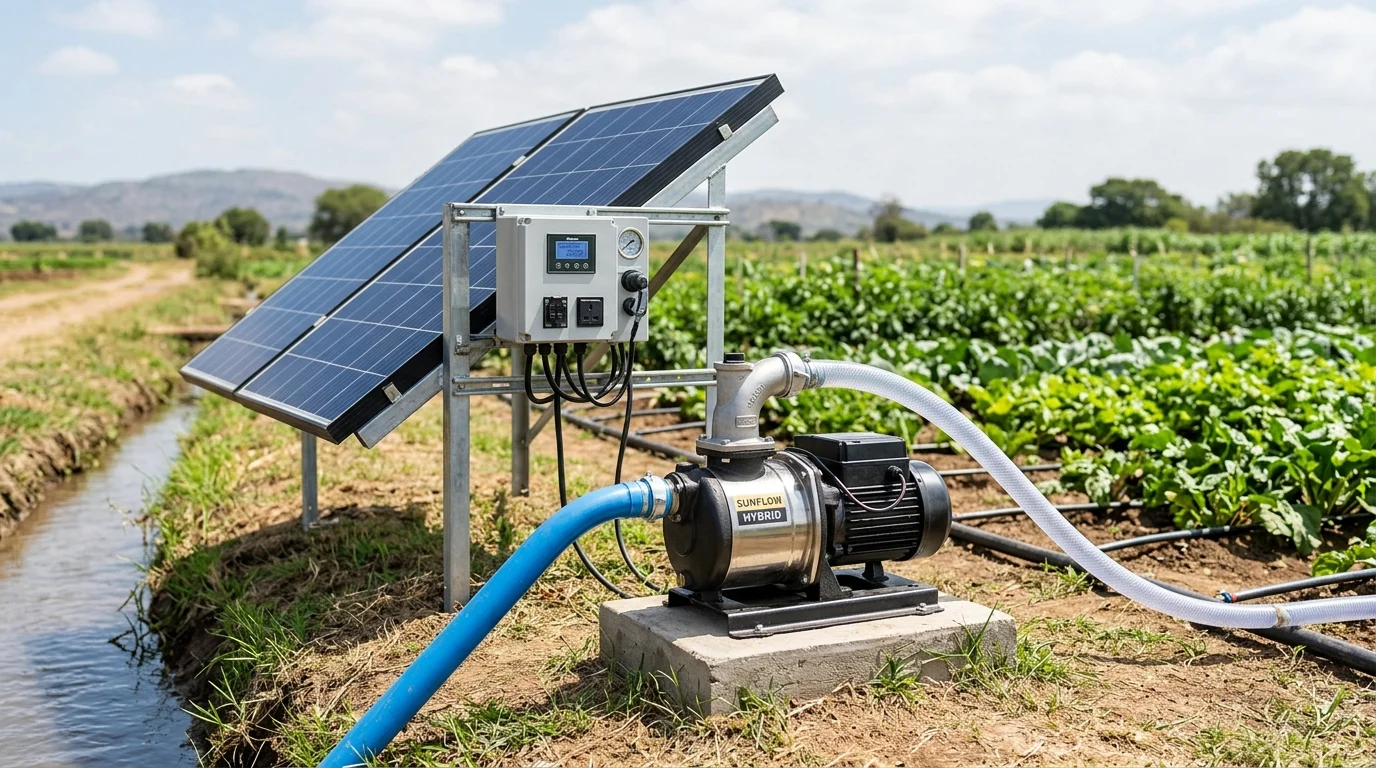
Introduction
Choosing a solar-powered hybrid water pump means balancing water demand, site conditions, and backup power needs rather than focusing on panel size alone. The right system must match the depth and quality of the water source, the required flow and pressure, and how often the pump must run when sunlight is limited. It also helps to understand how hybrid operation with grid or generator power affects reliability, operating cost, and long-term maintenance. This guide explains the main selection criteria, from source conditions and pump type to materials, control options, and application goals, so you can narrow down a system that performs efficiently in real-world conditions.
Selection Criteria for a Solar-Powered Hybrid Water Pump
Hybrid solar water pumps integrate photovoltaic (PV) DC power with alternating current (AC) sources—such as the utility grid or diesel generators—to ensure uninterrupted water delivery regardless of irradiance levels. Procuring the optimal system requires a granular analysis of the deployment environment and the strategic objectives of the installation.
Operating Profile and Water Source Conditions
The primary determinant in pump selection is the hydrogeological profile of the water source. For deep well applications, static water levels and dynamic draw-down rates must be mapped against seasonal variations. Submersible hybrid pumps deployed in boreholes exceeding 120 meters in depth face significant hydrostatic pressure, necessitating robust casing materials like AISI 304 or 316 stainless steel. Additionally, water quality metrics—such as a sand content threshold exceeding 50 grams per cubic meter (g/m³)—will dictate the need for specialized impellers or abrasion-resistant hydraulic components to prevent premature degradation.
Project Goals and Application Requirements
Application-specific demands dictate the system’s operational duty cycle. Agricultural irrigation projects typically require high-volume output during specific daylight windows, whereas municipal water reservoirs demand a continuous baseline flow, often necessitating automatic transfer switches (ATS) to seamlessly blend solar and grid power at night. For instance, a medium-scale irrigation system requiring 500 cubic meters (m³) of water daily must balance solar array sizing with the anticipated AC generator run-time to minimize fuel consumption while meeting peak crop hydration schedules.
Key Technical Specifications to Verify

Accurate specification of hydraulic and electrical parameters is critical to ensuring system efficiency and longevity. Engineers must rigorously evaluate the pump’s performance curves against the site’s unique hydraulic demands and available power infrastructure.
Flow Rate, Total Dynamic Head, and Daily Water Demand
Total Dynamic Head (TDH) and daily volumetric requirements form the baseline for hydraulic sizing. TDH must account for static lift, operating pressure, and friction losses through piping networks. Undersizing leads to flow deficits, while oversizing causes inefficient operation and potential cavitation.
| Application Scale | Typical TDH Range (m) | Target Flow Rate (m³/h) | Recommended Pump Type |
|---|---|---|---|
| Shallow Irrigation | 10 – 50 | 20 – 100 | Surface Centrifugal |
| Mid-Depth Livestock | 50 – 150 | 5 – 25 | Multi-stage Submersible |
| Deep Well Municipal | 150 – 300+ | 10 – 50 | High-Head Submersible |
Pump, Motor, and Controller Configuration
The integration of the motor and controller dictates the electromechanical efficiency of the system. Permanent Magnet Synchronous Motors (PMSM) are highly favored in solar applications due to their high power density and efficiencies reaching up to 92%, compared to 75-85% for standard asynchronous AC motors. The variable frequency drive (VFD) or hybrid controller must feature advanced Maximum Power Point Tracking (MPPT) algorithms. An MPPT tracking efficiency of ≥99% is essential to maximize water output during low-irradiance periods at dawn and dusk.
Power Source and System Compatibility
Hybrid systems require sophisticated power management electronics capable of accepting dual inputs simultaneously or switching between them seamlessly. Controllers must support wide DC input voltage ranges—typically between 200V and 800V DC for mid-to-large systems—to accommodate varying string configurations and temperature-induced voltage fluctuations. Furthermore, the controller should possess programmable logic to prioritize solar DC power, drawing from the AC grid or a 3-phase 380V/415V diesel generator only when solar output drops below the minimum operational frequency threshold (usually around 30 Hz).
Quality, Compliance, and Supplier Evaluation
Beyond baseline specifications, the durability of a hybrid solar pumping system relies heavily on stringent quality control and the manufacturer’s adherence to international standards. Evaluating vendor credentials mitigates the risk of early component failure in harsh environments.
Reliability and Performance Indicators
Industrial buyers must assess quantitative reliability metrics, such as Mean Time Between Failures (MTBF). High-tier hybrid controllers should exhibit an MTBF exceeding 50,000 hours, while the submersible pump ends should demonstrate a defect rate of less than 0.5% across a standard production run. Thermal management of the controller is another critical indicator; heat sinks and active cooling mechanisms must maintain internal junction temperatures below 85°C to prevent derating during peak ambient heat.
Certifications, Testing, and Documentation
Regulatory compliance serves as an objective benchmark for component quality. Procurement teams should mandate compliance with IEC 62253, which specifies the performance and testing procedures for photovoltaic water pumping systems. Submersible motors must carry a minimum ingress protection rating of IP68, guaranteeing complete hermetic sealing against continuous submersion at specified depths. Additionally, CE marking and ISO 9001:2015 certifications provide assurance regarding electrical safety and consistent manufacturing processes, respectively.
Warranty, Spare Parts, and After-Sales Support
The total value of a supplier extends into their post-installation support infrastructure. Standard industry warranties for hybrid solar pumps typically cover 18 to 24 months for the pump and motor, and up to 3 to 5 years for the electronic controller. Buyers must verify the guaranteed availability of critical spare parts—such as impellers, mechanical seals, and controller logic boards—for a minimum of 10 years post-purchase. Global projects also necessitate suppliers with established regional service centers capable of responding to technical escalations within a 48-hour window.
Cost, Installation, and Logistics Considerations
Financial feasibility and project timelines are heavily influenced by the holistic costs of procurement, deployment, and international shipping. A robust procurement strategy must account for all hidden variables outside the initial hardware quote.
Total Cost of Ownership
While the capital expenditure (CAPEX) for a hybrid solar pump is 20% to 40% higher than a conventional AC pump due to the specialized controller and PV array, the Total Cost of Ownership (TCO) is significantly lower. By displacing diesel fuel consumption, industrial agricultural operators frequently achieve a return on investment (ROI) within 24 to 36 months. A comprehensive TCO analysis must model the localized cost of AC power (grid tariffs or diesel at $1.20+ per liter) against the projected 20-year lifespan of the solar array and the 8-to-10-year lifespan of the pump hardware.
Site and Installation Variables
Site-specific constraints directly impact installation complexity and ancillary material costs. The distance between the solar array, the hybrid controller, and the wellhead dictates the required cross-sectional area of the submersible drop cable. To prevent excessive power loss, engineers must calculate cable sizing to ensure voltage drop remains strictly below 3% over the run length. Furthermore, lightning protection and robust grounding arrays (typically requiring ground resistance < 4 ohms) must be integrated into the site plan to protect sensitive VFD electronics from transient surges.
Shipping, Lead Time, and Packaging
International logistics introduce lead times and shipping risks that must be managed proactively. Standard production lead times for commercial-scale hybrid pumps range from 3 to 6 weeks, depending on the manufacturer’s backlog and the specification of custom impellers. For bulk procurement, Minimum Order Quantities (MOQs) may apply, often starting at 5 to 10 units for factory-direct pricing. To prevent transit damage, buyers must stipulate the use of ISPM 15 compliant fumigated wooden crates, particularly for heavy cast-iron or stainless steel components that can exceed 250 kg per unit.
Decision Process and Buyer Checklist
Standardizing the procurement workflow ensures that all technical, financial, and logistical criteria are met without oversight. A structured decision matrix empowers buyers to objectively filter suppliers and select the optimal hybrid pumping solution.
Step-by-Step Vendor Evaluation Process
The evaluation sequence should commence with a Request for Information (RFI) to screen vendor capabilities, followed by a detailed Request for Quotation (RFQ) requiring exact performance curves for the proposed pump. Procurement teams should conduct technical audits of the shortlisted manufacturers, prioritizing those who offer proprietary software for accurate solar array sizing and ROI modeling.
| Evaluation Criteria | Weighting (%) | Key Indicators for Maximum Score |
|---|---|---|
| Technical Capability | 40% | MPPT >99%, PMSM efficiency >90%, IP68 rating |
| Manufacturer Reliability | 25% | ISO 9001, IEC 62253 compliance, <1% defect rate |
| After-Sales & Warranty | 20% | 3+ year controller warranty, localized service network |
| Cost & Logistics | 15% | Competitive TCO, lead time < 4 weeks, ISPM 15 packing |
Specification Checklist and Comparison Criteria
Before issuing a final purchase order, project engineers must validate a comprehensive specification checklist against the site data. This includes confirming the exact hybrid blending logic (e.g., whether the controller can simultaneously mix 60% solar and 40% grid power, or if it acts as a hard switch). Furthermore, the checklist must verify the pump’s hydraulic curve intersects the system’s TDH exactly at the desired flow rate, the controller’s maximum open-circuit voltage (Voc) tolerance exceeds the PV array’s cold-weather maximum by at least 15%, and all necessary dry-run protection sensors are included in the bill of materials.
Key Takeaways
- The most important conclusions and rationale for Solar-powered hybrid water pump
- Specs, compliance, and risk checks worth validating before you commit
- Practical next steps and caveats readers can apply immediately
Frequently Asked Questions
What makes a solar-powered hybrid water pump “hybrid”?
It uses solar PV as the primary power source and switches to AC grid or a generator when sunlight is insufficient, keeping water supply stable day and night.
How do I size the right pump for my site?
Match the pump curve to your required daily water volume, flow rate, and total dynamic head, including static lift, pipe friction, and outlet pressure.
Which pump type is best for deep wells?
For deep boreholes, choose a multi-stage or high-head submersible pump with stainless steel construction, especially when depth exceeds 120 meters or water quality is abrasive.
What controller features should I look for?
Choose a hybrid controller with high-efficiency MPPT, wide DC input range, automatic source switching, and priority logic that uses solar first before grid or generator backup.
Why consider Eternal Hybrid Tech for a hybrid solar pumping project?
Eternal Hybrid Tech focuses on intelligent photovoltaic microgrid solutions with day/night energy support, helping commercial and industrial users reduce energy costs and maintain reliable pumping.