Introduction
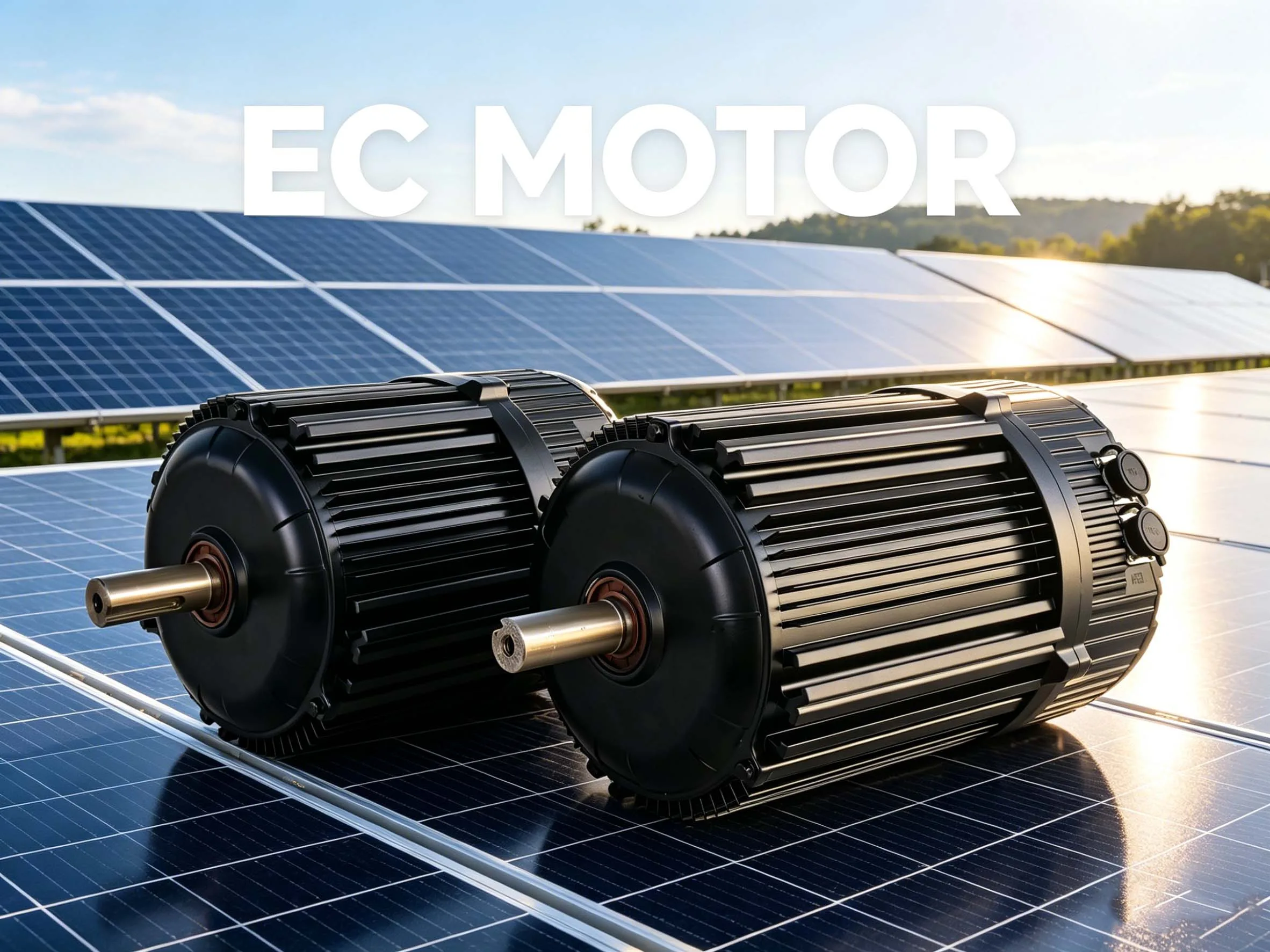
Commercial buildings are under growing pressure to lower energy use while meeting stricter acoustic standards in HVAC, refrigeration, and ventilation systems. Solar EC motors address both concerns by combining renewable-ready DC operation with electronically controlled commutation that reduces vibration, tonal hum, and mechanical wear. This introduction outlines why motor noise matters in occupied spaces, how Solar EC technology differs from conventional AC and brushed DC designs, and what facility teams can gain from quieter, more efficient equipment integration.
How Solar EC Motors Reduce Noise in Commercial Systems
The integration of decentralized renewable energy into commercial HVAC, refrigeration, and ventilation systems has accelerated the adoption of Solar EC (Electronically Commutated) Motors. Beyond their primary advantage of energy efficiency and direct current compatibility, these advanced motors play a critical role in mitigating noise pollution. Commercial facilities increasingly face strict acoustic regulations, with municipal ordinances and occupational health guidelines often capping continuous indoor ambient noise at 45 to 50 dB(A) for office and administrative environments. Meeting these stringent thresholds requires equipment engineered specifically for acoustic optimization.
Traditional alternating current (AC) motors and standard brushed direct current (DC) motors inherently produce mechanical and electromagnetic noise profiles that are difficult to mask without heavy, expensive acoustic insulation. Solar EC Motors address these acoustic challenges at the source. By leveraging sophisticated semiconductor-based commutation and native DC operation, they eliminate the most common vectors of motor noise, providing a quieter baseline for commercial infrastructure.
Why noise reduction matters in commercial environments
In commercial environments such as hospitals, educational facilities, and open-plan offices, acoustic ergonomics directly impact productivity and occupant well-being. Prolonged exposure to the low-frequency hums typically generated by legacy AC motors—often peaking in the 100 to 120 Hz range—induces cognitive fatigue and violates modern indoor environmental quality (IEQ) standards. Furthermore, exterior commercial equipment, such as rooftop condenser units, must comply with strict property-line noise ordinances to prevent disturbances in mixed-use zoning areas.
Noise reduction is no longer considered a luxury but a fundamental compliance metric. Facilities that fail to manage acoustic output often incur secondary costs through the mandated installation of sound attenuators, acoustic louvers, or heavy enclosures. By addressing noise generation at the electromechanical level, facilities can streamline system design, reduce the physical footprint of HVAC units, and maintain compliance without relying on costly aftermarket dampening solutions.
How Solar EC Motors support low-noise operation
Solar EC Motors support low-noise operation primarily through their brushless architecture and seamless integration with photovoltaic power sources. Because they operate natively on direct current, they can be wired directly to solar arrays or DC microgrids without requiring intermediate phase inverters. This eliminates the high-frequency switching noise and inverter hum commonly associated with converting solar DC power to AC for traditional induction motors.
Additionally, the built-in microprocessors in Solar EC Motors continuously monitor load requirements, adjusting the motor speed in real-time. Instead of cycling violently between zero and 100 percent capacity—a process that creates disruptive acoustic transients and mechanical shocks—these motors ramp up and down smoothly. This continuous, modulated operation ensures that the system only generates the minimum aerodynamic and mechanical noise necessary to meet the immediate environmental demand.
What Makes Solar EC Motors Quieter Than Conventional Motors
The acoustic superiority of Solar EC Motors stems from a fundamental shift in electromechanical design. Operating at electrical efficiencies of up to 90%, compared to the 60% to 70% typical of shaded-pole or standard AC induction motors, EC units generate significantly less waste heat. This high efficiency translates directly to lower cooling requirements, allowing the motors to utilize smaller, quieter integrated cooling fans or rely entirely on passive convection.
By replacing mechanical wear components with solid-state electronics, Solar EC Motors remove the physical friction that plagues conventional motor designs. This architectural difference fundamentally alters the acoustic signature of the equipment, shifting the noise profile away from harsh, tonal frequencies and toward lower-amplitude, broadband sound that is easily absorbed by standard building materials.
How electronic commutation and speed control reduce noise
Electronic commutation replaces the physical carbon brushes and commutators found in traditional DC motors with a solid-state printed circuit board (PCB). This eliminates the mechanical scraping and sparking that generate high-frequency acoustic noise and electromagnetic interference (EMI). The magnetic field is rotated electronically, resulting in a perfectly synchronized, frictionless rotation of the rotor.
Furthermore, the integrated Pulse-Width Modulation (PWM) speed control allows the motor to operate at partial loads. According to the fan laws, aerodynamic noise is proportional to the fifth power of the rotational speed. By reducing the motor speed by just 20% using PWM control, the resulting aerodynamic noise can drop by nearly 50% (roughly 4 to 5 dB(A)). Conventional motors lacking this granular control must run at full speed, generating maximum noise regardless of the actual system load.
Which system specifications affect acoustic performance
Several specific engineering tolerances and specifications dictate the final acoustic performance of a Solar EC Motor. Stator slot design and the skewing of magnetic poles are critical for reducing ‘cogging torque’—the jerky, magnetic resistance that causes vibration and low-frequency humming at low RPMs. High-quality Solar EC Motors utilize optimized magnetic topologies to ensure smooth rotation even at minimal speeds.
Bearing quality is another decisive factor. High-precision, permanently lubricated ball bearings, typically rated for an L10 life expectancy of 40,000 to 50,000 hours, prevent the gradual onset of grinding or rattling noises associated with bearing degradation. Additionally, the rotor balancing grade—often specified to ISO 1940-1 standards at G6.3 or better—ensures that eccentric mechanical forces do not translate into structural vibrations.
How to compare Solar EC Motors with conventional options
When comparing Solar EC Motors against conventional options, engineers must look at both the baseline noise output and the operational flexibility. Standard AC induction motors are bound by grid frequency, resulting in a constant, unyielding speed and noise level unless paired with a bulky Variable Frequency Drive (VFD), which introduces its own acoustic whine.
| Motor Technology | Commutation Method | Typical Efficiency | Speed Control | Baseline Acoustic Profile (at 1500 RPM) |
|---|---|---|---|---|
| AC Induction | Phase Alternation | 60% – 70% | Requires external VFD | High low-frequency hum (100-120 Hz) |
| Standard Brushed DC | Mechanical (Brushes) | 70% – 80% | Voltage regulation | Moderate mechanical scraping / friction |
| Solar EC Motor | Solid-State Electronic | 85% – 90%+ | Integrated PWM | Low broadband noise, minimal vibration |
How to Evaluate Solar EC Motors for Noise Performance
Evaluating the acoustic profile of Solar EC Motors requires moving beyond theoretical specifications to analyze empirical acoustic data. Manufacturers often market motors as ‘whisper-quiet,’ but commercial procurement demands rigorous, standardized metrics. Engineers must distinguish between sound power level (Lw), which measures the total acoustic energy emitted by the motor, and sound pressure level (Lp), which measures the localized acoustic impact typically recorded at a standard distance of 1 meter.
Because Solar EC Motors operate across a wide variable speed range, single-point acoustic measurements are insufficient. A comprehensive evaluation must map the acoustic output across the motor’s entire operational curve, ensuring that resonant frequencies do not cause unexpected noise spikes at specific partial-load RPMs.
Which operating conditions reveal real-world noise levels
Real-world noise levels are rarely reflected by unladen bench tests. To accurately evaluate a Solar EC Motor, it must be tested under representative aerodynamic and mechanical loads. Operating the motor at 50%, 75%, and 100% capacity reveals how the acoustic signature changes as the PWM controller adjusts the power delivery. Certain speeds may align with the natural resonant frequency of the attached impeller or mounting bracket, amplifying structure-borne noise.
Furthermore, evaluating the motor in a simulated solar-direct environment is crucial. Fluctuations in solar irradiance can cause minor voltage variations. High-quality Solar EC Motors feature robust internal voltage regulation that maintains a stable RPM and acoustic profile despite these input fluctuations, whereas inferior models may exhibit audible surging or hunting as the voltage sags.
What acoustic metrics and test methods to use
Standardized testing protocols, such as ISO 3744 or DIN EN ISO 11203, provide reliable frameworks for measuring acoustic emissions in an anechoic or hemi-anechoic chamber. These standards ensure that background noise and room reverberation do not skew the data. Procurement teams should request acoustic test reports that adhere to these specific standards rather than relying on uncertified marketing claims.
Beyond overall dB(A) ratings, engineers should utilize one-third octave band analysis. This metric breaks the sound down into specific frequency bands, allowing evaluators to identify tonal spikes. For EC motors, this is particularly important for detecting switching frequencies from the internal electronics. If the PWM switching frequency is set too low (e.g., around 8 to 12 kHz), it can produce a highly irritating, high-pitched whine. Premium Solar EC Motors push this switching frequency above 16 kHz or even 20 kHz, moving it outside the range of human hearing.
How Design and Installation Improve Noise Reduction
Even a perfectly engineered, acoustically optimized Solar EC Motor will transmit disruptive noise if improperly integrated into the broader commercial system. System design and installation practices are responsible for mitigating structure-borne noise—vibrations that travel through mounting chassis, ductwork, and building frameworks before radiating as audible sound.
Implementing proper vibration isolation and structural decoupling can reduce structure-borne noise transmission by 5 to 8 dB(A). Conversely, rigid mounting to thin sheet metal enclosures can amplify motor vibrations, turning the casing into an acoustic sounding board. Therefore, acoustic optimization must be treated as a holistic system requirement, not just a component-level specification.
How proper sizing and installation minimize noise
Proper sizing is a highly effective, yet often overlooked, strategy for noise reduction. By slightly oversizing a Solar EC Motor for a given application, engineers can program the unit to operate continuously at 60% to 70% of its maximum RPM to meet the nominal load. Because EC motors maintain high efficiency even at partial speeds, this oversizing penalty is minimal regarding energy consumption, but it yields massive dividends in acoustic reduction by keeping the motor out of its highest, noisiest operational band.
During installation, mechanical decoupling is mandatory. Motors should be mounted using specialized anti-vibration isolators—typically rubber or elastomeric mounts with a specific durometer rating (e.g., 40 to 50 Shore A). Additionally, flexible canvas or elastomeric connectors should be used to isolate the motor and fan assembly from rigid ductwork, preventing the propagation of vibration through the building’s ventilation infrastructure.
Which standards and environmental factors affect results
Installation parameters should be guided by recognized acoustic standards, such as the ASHRAE guidelines for HVAC noise control. These standards help engineers calculate the acceptable Noise Criteria (NC) or Room Criteria (RC) for specific commercial spaces. The environmental context—such as whether the motor is installed in a highly reverberant mechanical room with hard concrete surfaces or a dampened enclosure—drastically affects the perceived noise level.
Environmental protection standards also play an inadvertent role in acoustics. Solar EC Motors designed for harsh environments often carry high Ingress Protection ratings (e.g., IP54 or IP55). The robust, sealed cast-aluminum housings required to achieve these IP ratings inherently act as excellent acoustic dampeners, containing high-frequency electronic noise and internal mechanical sounds much more effectively than open-drip-proof (ODP) enclosures.
How to Make Smart Retrofit and Procurement Decisions

Strategic procurement of Solar EC Motors requires balancing initial capital expenditure (Capex) against long-term operational and acoustic benefits. While EC technology commands a premium over legacy AC induction motors, the combination of energy savings, off-grid solar integration, and eliminated acoustic mitigation costs rapidly offset the initial purchase price.
Facilities upgrading their infrastructure often realize a return on investment (ROI) within 18 to 36 months. This rapid payback is driven by 30% to 50% reductions in energy consumption, coupled with the avoidance of secondary acoustic treatments like sound baffles and heavy silencers that would otherwise be necessary to meet noise ordinances.
When retrofitting Solar EC Motors delivers value
Retrofitting delivers the highest value in high-uptime commercial environments where both energy costs and acoustic comfort are critical. Hospitals, data centers, and high-end commercial office buildings stand to gain the most. In a typical retrofit scenario, replacing an aging AC rooftop ventilation motor with a Solar EC equivalent can drop localized system noise by 8 to 12 dB(A), instantly resolving tenant complaints and compliance issues.
| Retrofit Evaluation Metric | Conventional AC Motor System | Solar EC Motor Retrofit | Net Commercial Impact |
|---|---|---|---|
| System Noise Level | Relatively high noise; frequent complaints during long operating hours | Reduced by ~8–12 dB(A); significantly quieter | Improves tenant satisfaction; reduces complaints and disputes |
| Energy Cost | Fully grid-dependent; high energy consumption | Solar-powered + high-efficiency EC motor; significantly lower energy use | Reduces long-term operating expenses (OPEX) |
| Operational Efficiency | Fixed speed; lower efficiency | Variable speed control; optimized performance | Improves overall system efficiency; shorter payback period |
| Performance in High-Usage Environments | High cost burden in long runtime scenarios | Highly efficient in hospitals, data centers, premium offices | Higher ROI in high-load applications |
Key Takeaways
- The most important conclusions and rationale for Solar EC Motors
- Specs, compliance, and risk checks worth validating before you commit
- Practical next steps and caveats readers can apply immediately
Frequently Asked Questions
How do Solar EC Motors reduce noise in commercial ventilation systems?
They use brushless electronic commutation, smooth speed control, and native DC operation to reduce friction, vibration, inverter hum, and sudden start-stop noise in fans and HVAC equipment.
Why are Solar EC Motors quieter than traditional AC motors?
Solar EC Motors avoid mechanical brushes and operate with precise electronic control, producing less heat, less vibration, and fewer low-frequency hums than conventional AC induction motors.
Can Solar EC Motors help meet commercial noise regulations?
Yes. Their lower acoustic output helps offices, hospitals, schools, and mixed-use buildings reduce equipment noise and support compliance with indoor and property-line noise limits.
What applications benefit most from quiet Solar EC Motor operation?
Commercial HVAC, refrigeration, rooftop ventilation, industrial fans, solar water pumps, and cooling systems benefit where lower noise, energy savings, and reliable solar-supported operation are required.