There are many common types of industrial fans available on the market, but how much do you actually know about them? And do you know how to choose the one that best suits your needs? This article focuses on introducing three typical types of industrial fans: axial flow fans, negative pressure fans, and centrifugal fans. It will provide a detailed overview of each type in terms of their working principles, structures, application scopes, as well as advantages and disadvantages.
1. Definition and Working Principle
(1) Axial Flow Fan
Air flows parallel to the fan’s axis. Featuring an impeller similar to a propeller, it delivers a large air volume but operates at low air pressure.It consists of a propeller-shaped impeller and a circular housing, making it suitable for duct-mounted or wall-mounted installations.
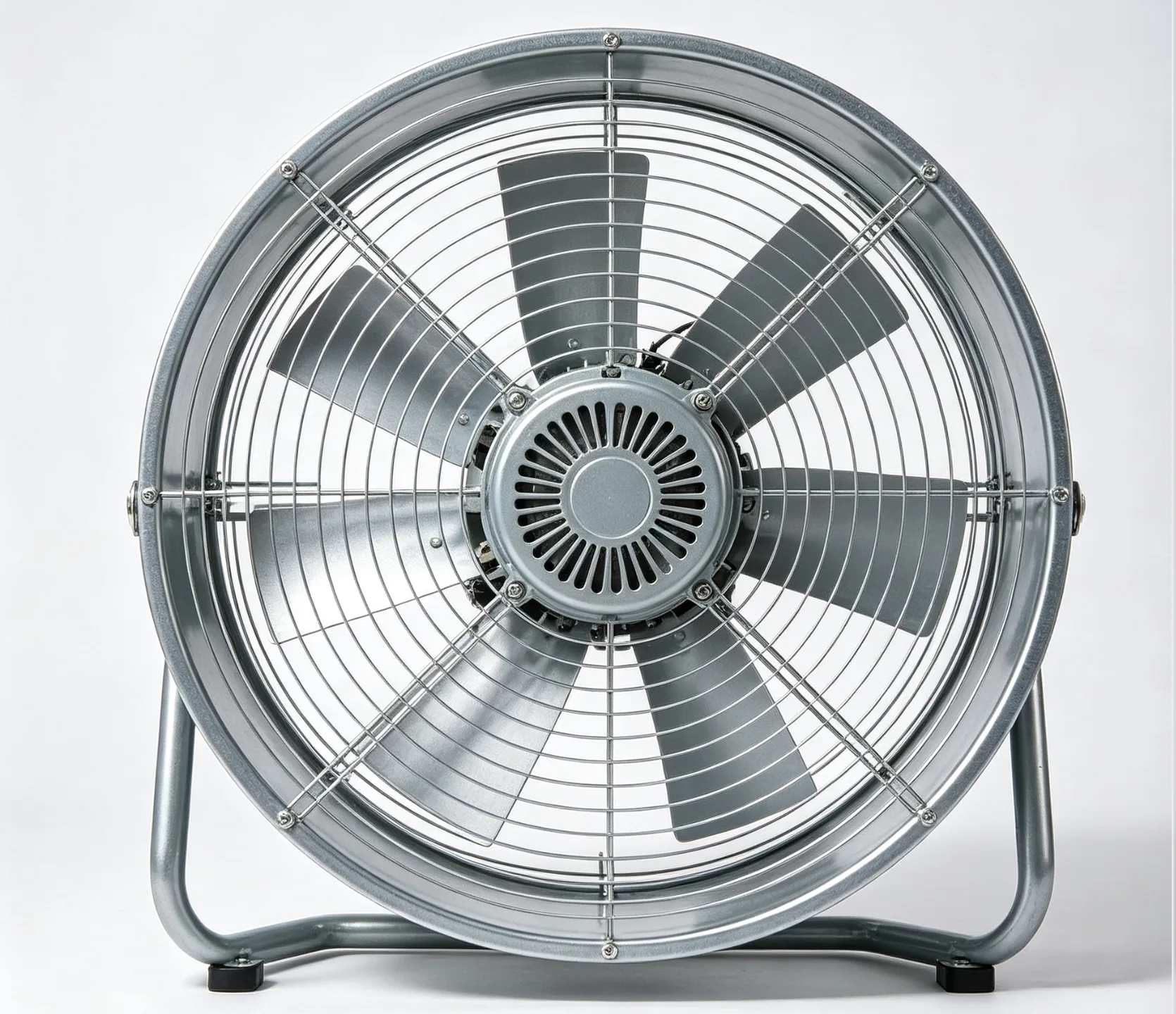
(2) Negative Pressure Fan
It exhausts air in a single direction, creating negative pressure indoors. This design makes it ideal for quickly removing high-temperature and high-humidity air.Equipped with a large-diameter impeller and a square or circular frame, it is often fitted with shutters and suitable for wall-mounted or window-mounted setups.
(3) Centrifugal Fan
Air flows radially and is thrown outward by the centrifugal force generated by the impeller, producing high air pressure. This makes it well-suited for complex duct systems.Its impeller can be forward-curved, backward-curved, or radial, and it is paired with a volute (spiral casing) to guide airflow—ideal for high-air-pressure scenarios.
2. Performance Characteristics
| Characteristic | Axial Flow Fan | Negative Pressure Fan | Centrifugal Fan |
| Air Volume (m³/h) | 1000-50,000 | 5000-100,000 | 500-30,000 |
| Air Pressure (Pa) | 50-500 | 100-800 | 500-5000 |
| Airflow Direction | Axial, bidirectional | Unidirectional (exhaust) | Radial |
| Noise Level (dB) | 50-80 | 60-90 | 60-85 |
| Efficiency | High (low pressure) | Medium-high (exhaust) | High (high pressure) |
3. Application Scope
Axial Flow Fans: Used for building ventilation, air supply/exhaust in air conditioning systems, and heat dissipation (e.g., cooling towers, indoor units of air conditioners).
Negative Pressure Fans: Applied for rapid air exhaust, cooling, and dehumidification (e.g., livestock farms, industrial workshops, greenhouses).Centrifugal Fans: Suitable for high-air-pressure scenarios and complex duct systems (e.g., industrial dust removal, boiler draft ventilation, material conveying).
4. Comparison of advantages and disadvantages
| Fan Type | Advantages | Disadvantages |
| Axial Flow Fan | Simple structure, low cost, large air volume, bidirectional ventilation | Low air pressure, not suitable for long ducts |
| Negative Pressure Fan | High exhaust efficiency, suitable for high-temperature and high-humidity environments, easy installation | High noise level, exhaust-only function |
| Centrifugal Fan | High air pressure, suitable for complex duct systems, stable operation | Complex structure, high cost, relatively high noise |
5. Case Study: Application of Negative Pressure Fans in Livestock Farms
Livestock farmers are seeking ways to minimize production costs. To achieve this, they must implement scientific disease prevention, proper management, and appropriate feeding practices, as well as ensure good living conditions. A key characteristic of high-density pig farming is the intensive housing of large numbers of pigs. Additionally, intensive farming leads to high levels of exhaust emissions, making good ventilation essential for multi-story pig farms.
Ningbo Volcano Electric uses EC fans with a permanent magnet design, achieving energy efficiency up to IE5 and IE5+ standards. These fans provide annual energy savings of 40% to 70%, making them ideal for centralized pig houses, multi-story pig farms, and installations with deodorizing wet curtains.In multi-story pig farming setups, the use of centralized fan ventilation combined with a centralized deodorization and filtration system enables efficient treatment of waste gas, effectively achieving zero gas pollution.
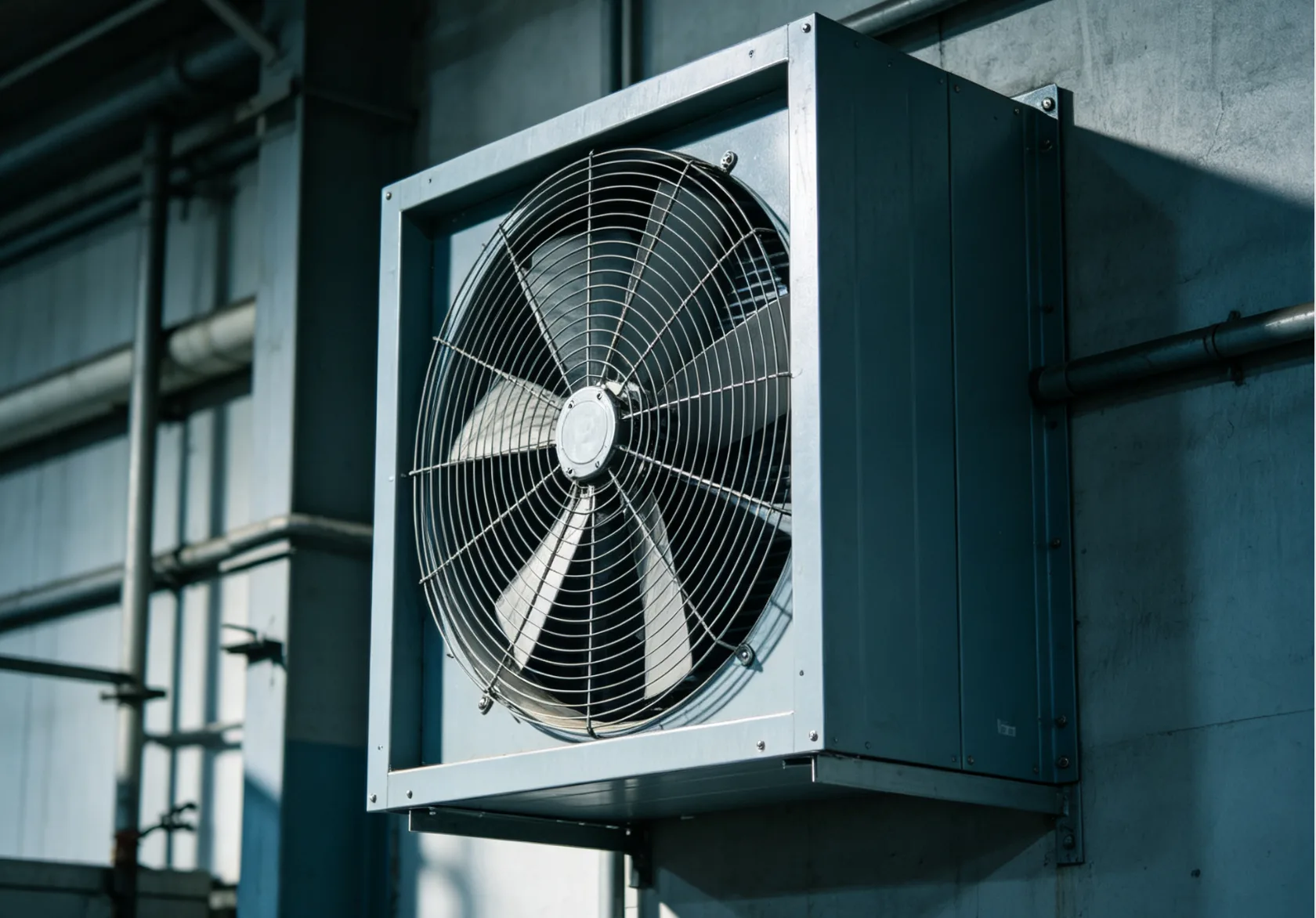
Our company’s EC fan products support power ranging from 0.75kW to 5.5kW. Moreover, they feature innovative improvements compared to ordinary EC fans, as they can utilize a hybrid power supply of solar energy and AC, further reducing energy expenses. This system requires no batteries and can operate entirely on solar power, making it more economical and reliable.
There are mainly three operating modes, which automatically switch according to weather conditions—offering remarkable convenience and intelligence.
Mode 1:Solar power directly drives
Solar power drives only, no AC power.
Solar power directly drives the motor when it is sufficient.
The motor runs at a lower speed when solar power is insufficient, based on solar power tracking algorithm.
Mode 2:Solar power & AC power hybrid drives
When soalr power is in sufficient, solar power complement with AC power, and auto-balancing.
AC power input ratio based on ral-time soalr power generation.
Stable output power anytime.
Mode 3:AC power drives only
When there is no power, only AC power will drive the motors.
The high-negative-pressure EC fans offer a static pressure of 150 Pa and an air volume of 28,000 m³/h (cubic meters per hour). Customized fan models can even meet a maximum static pressure requirement of 400 Pa. Equipped with EC motors as standard, these fans deliver exceptional energy efficiency, low noise levels, and high operational performance. Additionally, the direct connection to electronic control modules enables precise collection of fan data for accurate control.
A key characteristic of high-density pig farming is the high concentration of livestock. This intensive farming environment also results in high-density waste gas emissions, making efficient, eco-friendly, and sustainable ventilation a top priority for multi-story pig farms.
In multi-story pig farming setups, the use of centralized fan ventilation combined with a centralized deodorization and filtration system allows for effective treatment of waste gas, essentially achieving zero gas pollution. This configuration also simplifies inspection and maintenance processes, eliminating construction risks for maintenance personnel that would otherwise arise from working at height.
For a breeding pig farm with 10,000 basic sows, calculations based on past cases show that approximately 360 to 400 units of 900mm high-pressure fans are required. Using the aforementioned energy-saving data (calculated with 380 fans):
Total annual energy saved: 7,744 kWh/fan × 380 fans = 2,942,720 kWh
Electricity unit price: RMB 0.7 per kWh
Annual cost savings: RMB 2,060,000
In summary, replacing the traditional AC fans in pig farms with Huoshan’s high-negative-pressure EC fans can significantly reduce electricity expenses. This replacement maintains the original air volume, air speed, and air supply method while adding a noise reduction function—effectively reducing the energy consumption of fan operation and achieving remarkable energy conservation and emission reduction results.
In summary, replacing traditional AC fans in pig farms with Volcano’s high-negative-pressure EC fans can significantly lower electricity costs. This replacement retains the original air volume, air speed, and air supply method while incorporating a noise reduction feature—efficiently decreasing fan energy consumption and delivering outstanding energy savings and emission reduction outcomes.