Introduction
Office buildings face a difficult cooling equation: HVAC is one of the largest energy expenses, yet the highest demand often arrives when electricity prices and grid strain are also at their peak. Solar air conditioning changes that equation by using available sunlight to offset part of the cooling load, especially during hot daytime hours. This article examines whether that advantage makes it a better choice than traditional systems for offices, comparing energy use, operating costs, installation complexity, building fit, and long-term performance. With that context in place, the discussion can move from broad sustainability claims to the practical conditions that determine when solar cooling delivers measurable value.
Why Solar Air Conditioning Is Gaining Attention in Offices
Commercial real estate is undergoing a structural shift toward sustainable building operations, driven by volatile energy markets and stringent environmental regulations. Among the most energy-intensive systems in commercial facilities, climate control represents a primary target for optimization.
Solar air conditioning has emerged as a viable alternative to conventional grid-reliant systems. By harnessing solar insolation to power or supplement cooling cycles, these systems align building operations with modern efficiency standards while mitigating exposure to fluctuating utility rates.
Energy costs, peak demand, and decarbonization goals
The financial and environmental pressures on office building operators have never been higher. Heating, ventilation, and air conditioning (HVAC) typically accounts for 40% to 50% of a commercial building’s total energy consumption. In regions with tiered pricing structures, peak demand charges can easily reach $15 to $20 per kilowatt (kW), disproportionately penalizing facilities during hot summer afternoons when cooling loads peak.
Concurrently, corporate decarbonization goals and local benchmarking laws mandate significant reductions in greenhouse gas emissions. Solar air conditioning directly addresses both challenges by shifting a substantial portion of the cooling load away from the primary electrical grid during the most expensive and carbon-intensive hours of the day.
Where solar air conditioning fits in office buildings
Solar air conditioning integrates most effectively into mid-to-large office buildings characterized by predictable daytime occupancy patterns. Because the highest demand for office cooling directly correlates with peak solar irradiation—typically between 10:00 AM and 4:00 PM—the generation curve naturally matches the consumption curve.
Facilities with expansive, unshaded flat roofs offer the ideal footprint for the necessary solar arrays or thermal collectors. Furthermore, modern solar HVAC units are designed to interface seamlessly with existing Building Management Systems (BMS), allowing facility managers to monitor solar fraction, grid consumption, and overall system efficiency in real time without requiring a complete overhaul of internal ductwork.
Solar Air Conditioning vs Traditional Systems
Evaluating solar air conditioning against traditional HVAC systems requires a clear understanding of the underlying technologies and their respective performance benchmarks. The transition from grid-dependent cooling to solar-assisted cooling introduces new variables in system architecture and efficiency measurement.
System types to compare
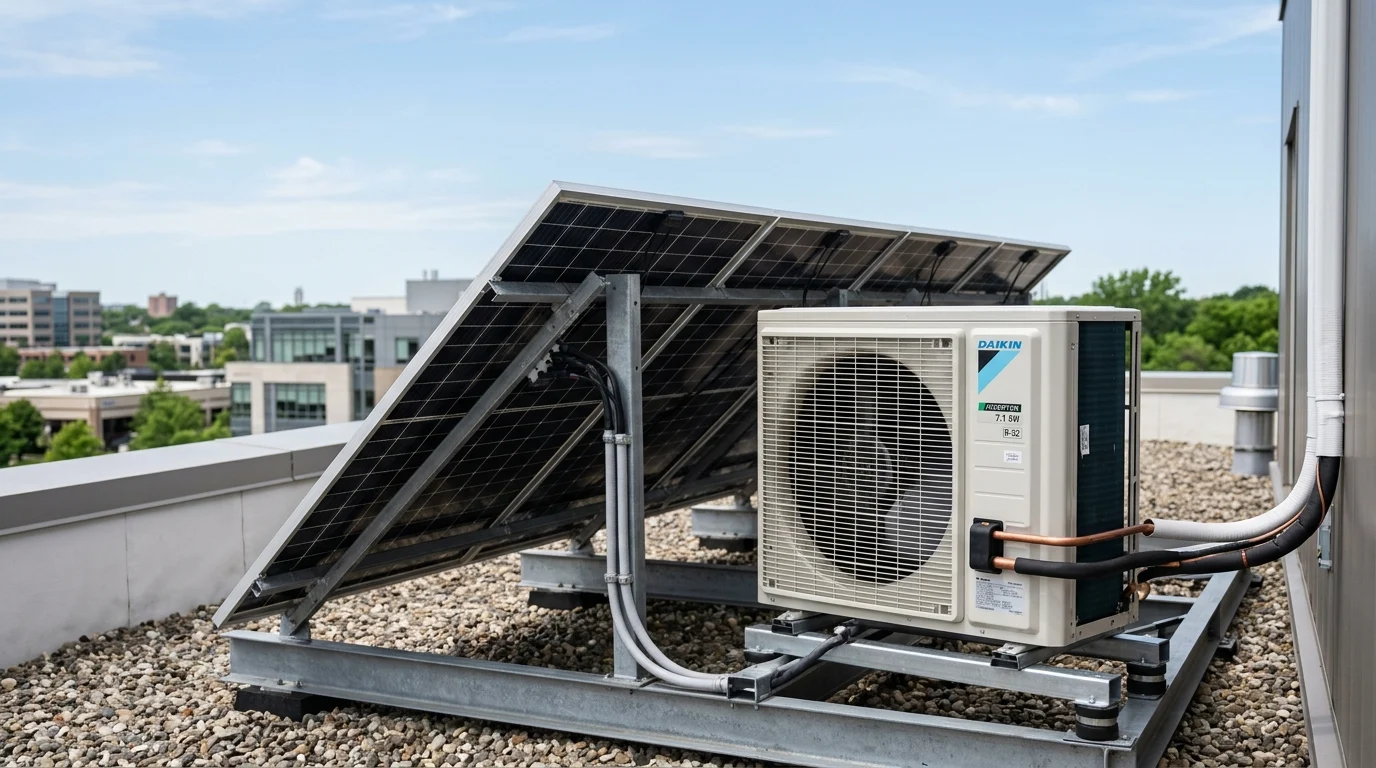
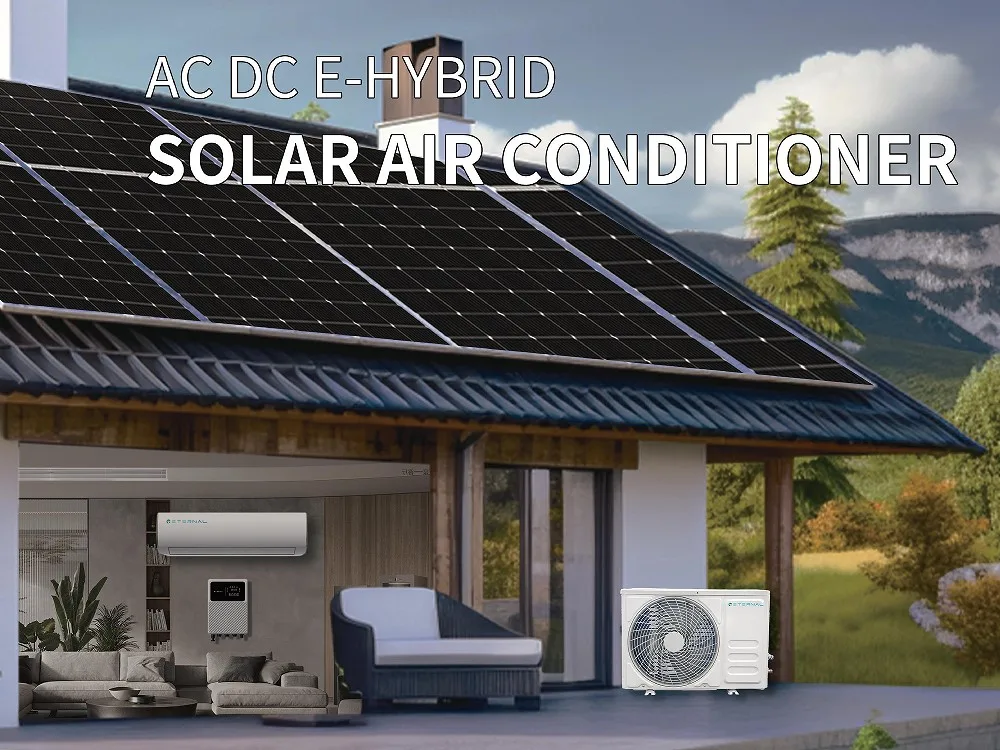
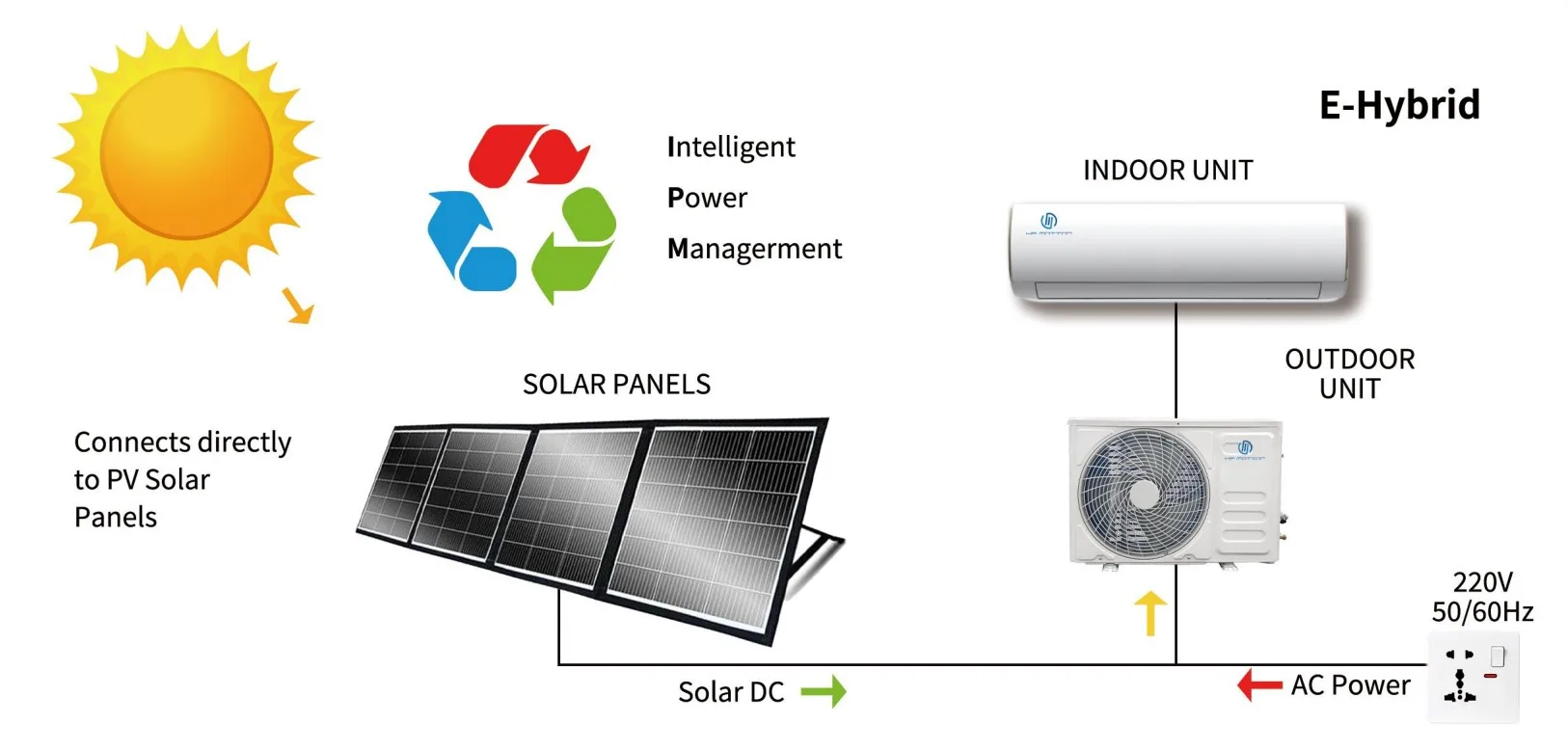
Commercial solar air conditioning primarily falls into two categories: solar photovoltaic (PV) driven systems and solar thermal systems. PV-driven systems utilize solar panels to generate direct current (DC) electricity, which powers a variable-speed DC inverter compressor. When solar power is insufficient, the system seamlessly draws alternating current (AC) from the grid.
Conversely, solar thermal systems use evacuated tube or flat-plate collectors to capture heat. This thermal energy is used to power an absorption chiller, which utilizes a heat-driven process (often involving lithium bromide and water) to provide cooling. Traditional systems, by contrast, are standard rooftop units (RTUs) or variable refrigerant flow (VRF) systems that rely entirely on grid-supplied AC power.
Key performance metrics
Efficiency in traditional air conditioning is typically measured by the Seasonal Energy Efficiency Ratio (SEER) or Energy Efficiency Ratio (EER). Standard commercial RTUs generally offer SEER ratings between 15 and 20. However, evaluating solar air conditioning requires examining the “effective SEER” or solar fraction—the percentage of the cooling load met by solar energy.
A hybrid solar PV air conditioner can achieve an effective SEER equivalent exceeding 35, as the direct utilization of DC power bypasses the typical inverter losses associated with converting grid AC to DC. In optimal conditions, high-efficiency solar thermal absorption chillers can reduce electrical consumption for cooling by up to 80% compared to conventional vapor-compression chillers.
How climate, load profile, and roof area affect results
The viability of solar air conditioning is heavily dependent on site-specific factors. Facilities in Sun Belt regions with high ambient temperatures and consistent clear skies yield the highest solar fractions, maximizing the return on investment. Conversely, buildings in higher latitudes or areas with frequent cloud cover may require larger collector arrays to achieve the same offset.
Roof area is a critical constraint; solar thermal systems generally require about 40 to 50 square feet of collector space per cooling ton. If the roof space is limited or heavily shaded by adjacent high-rises, a traditional highly efficient VRF system may prove more practical.
| System Type | Primary Power Source | Ideal Climate/Application | Typical Initial Cost Premium | Effective Efficiency Rating |
|---|---|---|---|---|
| Traditional Grid RTU | Grid AC Electricity | Universal | Baseline ($0) | SEER 15 – 20 |
| Solar PV DC Inverter | Solar PV (DC) + Grid (AC) | High sun exposure, high electricity rates | +25% to +40% | Effective SEER 35+ |
| Solar Thermal Absorption | Solar Heat + Minimal Grid | High thermal load, ample roof space | +50% to +80% | Up to 80% grid reduction |
Key Technical, Financial, and Operational Trade-Offs
Transitioning to solar-assisted cooling involves balancing higher upfront capital expenditures against long-term operational savings. Facility owners must weigh the technical capabilities of these systems against their financial and maintenance realities.
Main advantages
The primary advantage of solar air conditioning is the drastic reduction in operational expenditure (OPEX). By generating cooling power on-site, office buildings can flatten their demand curves, avoiding the steep peak-demand charges levied by utilities. This energy independence provides a hedge against future energy price inflation.
Additionally, solar HVAC systems operate with variable-speed DC compressors, which avoid the massive power surges associated with the “hard starts” of traditional AC compressors. This softer operational profile extends the lifespan of the mechanical components and reduces acoustic noise, improving the overall acoustic environment for office tenants.
Main limitations
Despite the operational benefits, solar air conditioning faces notable limitations. The most prominent is the intermittent nature of solar energy. While peak cooling loads generally align with peak sunlight, late afternoon or early evening operations—when the sun is low but ambient building heat remains high—require the system to revert to grid power or rely on expensive battery storage.
Space constraints also present a significant hurdle. A standard 10-ton commercial cooling load might require up to 500 square feet of unobstructed roof space for a solar thermal array. For densely packed urban office buildings with limited roof footprints, accommodating the necessary hardware without shading interference is often physically impossible.
Lifecycle cost, incentives, and maintenance factors
The lifecycle cost of solar air conditioning is heavily influenced by regional incentives. In the United States, for example, the Investment Tax Credit (ITC) can offset 30% or more of the installation costs for qualifying solar equipment, significantly altering the financial calculus. When combined with local utility rebates, the payback period for a solar HVAC system typically ranges from 4 to 8 years.
Maintenance factors must also be integrated into the lifecycle analysis. While the core refrigeration cycles are similar to traditional units, solar systems require specialized maintenance for the PV panels or thermal collectors. Thermal systems, in particular, demand rigorous monitoring of fluid levels, pump mechanics, and vacuum tube integrity, potentially increasing routine maintenance costs by 10% to 15% annually compared to standard RTUs.
How Office Owners Should Evaluate Adoption
Adopting solar air conditioning is a complex capital project that requires rigorous due diligence. Office owners must execute a structured evaluation process to ensure the technology aligns with the building’s physical constraints and the organization’s financial targets.
Assess building suitability and cooling loads
The evaluation process must begin with an ASHRAE Level 2 energy audit to establish a baseline of current cooling loads and energy consumption patterns. Facility managers should analyze interval meter data to pinpoint exact peak demand times and quantify the potential savings of shifting those loads.
Simultaneously, a structural assessment of the building’s roof is mandatory. Solar thermal collectors filled with fluid can add a dead load of 4 to 6 pounds per square foot, while PV arrays require specialized mounting hardware to withstand local wind uplift codes. If the roof requires replacement within the next five years, it is financially prudent to bundle the roof replacement with the solar HVAC installation.
Procurement, compliance, and vendor selection
Procurement of solar HVAC systems requires navigating strict compliance and interconnection standards. Equipment must carry appropriate certifications, such as UL listings in North America or CE marks in Europe, to satisfy commercial insurance requirements.
When selecting a vendor, owners should demand proven track records in commercial deployments rather than residential installations. It is critical to ensure that any grid-tied inverters comply with IEEE 1547 standards for distributed resources, aiming for hardware with a documented failure rate of less than 1%. Vendors should provide comprehensive performance guarantees backed by long-term service level agreements (SLAs).
Implementation options: retrofit or full replacement
Office owners must decide between a hybrid retrofit and a full system replacement. Retrofitting involves integrating solar PV directly into existing, compatible VRF or DC-inverter systems, which minimizes interior disruption and capital outlay.
Full replacement is generally reserved for buildings where existing HVAC infrastructure is nearing the end of its 15-to-20-year lifecycle. While a full replacement requires significant initial capital and logistical planning to minimize tenant downtime, it yields the highest overall efficiency gains by optimizing the entire cooling loop from generation to distribution.
| Implementation Strategy | Typical CAPEX Band (Per Ton) | Installation Downtime | Expected Energy Savings | Best Use Case |
|---|---|---|---|---|
| Hybrid PV Retrofit | $1,500 – $2,500 | Low (1-3 days) | 20% – 40% | Existing DC-compatible HVAC systems under 5 years old |
| Full Solar AC Replacement | $3,500 – $6,000 | High (1-3 weeks) | 50% – 70% | End-of-life HVAC systems requiring complete overhaul |
When Solar Air Conditioning Is the Better Choice
While solar air conditioning offers compelling environmental and operational benefits, it is not a universal solution for every commercial property. Identifying the scenarios where this technology outperforms traditional systems is crucial for maximizing return on capital.
Office scenarios where solar air conditioning performs best
Solar air conditioning delivers the highest value in office scenarios characterized by high sun exposure, elevated utility rates, and daytime-only occupancy. Facilities located in regions where commercial electricity rates exceed $0.15/kWh and peak demand charges are aggressively enforced will see the fastest amortization of the initial capital premium.
Furthermore, the technology is highly advantageous for owner-occupied buildings or single-tenant corporate headquarters with more than 10,000 square feet of available, unshaded roof space. In these environments, the organization can fully capture the long-term operational savings and directly leverage the installation to meet aggressive corporate net-zero or ESG (Environmental, Social, and Governance) commitments.
Decision criteria for selecting the right system
Ultimately, selecting the right system requires a stringent decision matrix. The primary criterion is the financial threshold: if the projected payback period, inclusive of all tax credits and local incentives, falls under 7 years, solar air conditioning is generally a superior financial choice.
Secondary criteria include the structural load capacity of the existing facility and the long-term ownership horizon. If a property owner intends to hold the asset for 10 to 15 years, the operational savings of a solar HVAC system will vastly outweigh the initial CAPEX. However, for short-term holds or heavily shaded urban properties, upgrading to high-efficiency traditional VRF systems remains the more pragmatic approach.
Key Takeaways
- The most important conclusions and rationale for Solar Air Conditioning
- Specs, compliance, and risk checks worth validating before you commit
- Practical next steps and caveats readers can apply immediately
Frequently Asked Questions
Is solar air conditioning better than traditional HVAC for office buildings?
It is often better for offices with strong daytime cooling loads, sunny roofs, and high peak electricity rates. It mainly cuts daytime grid use and demand charges rather than replacing every HVAC function.
Which office buildings are the best fit for solar air conditioning?
Mid-to-large offices with predictable 10 AM–4 PM occupancy, unshaded roof space, and expensive summer power tariffs usually see the best results. Limited roof area can reduce the solar fraction.
How much energy can a solar air conditioning system save?
Savings vary by climate and design, but hybrid solar PV cooling can reach an effective SEER above 35. Solar thermal options may cut cooling electricity use by up to 80% in strong conditions.
Can solar air conditioning work when sunlight is low or the grid is unstable?
Yes. Hybrid systems can switch to grid power when solar output drops, and microgrid support can improve resilience. Eternalmaxx solutions are designed for day/night energy support in commercial cooling applications.
Does solar air conditioning require replacing the whole office HVAC system?
Not always. Many commercial solar HVAC systems can integrate with existing ductwork and BMS controls. A site assessment should confirm roof capacity, load profile, and whether retrofit or hybrid deployment is best.