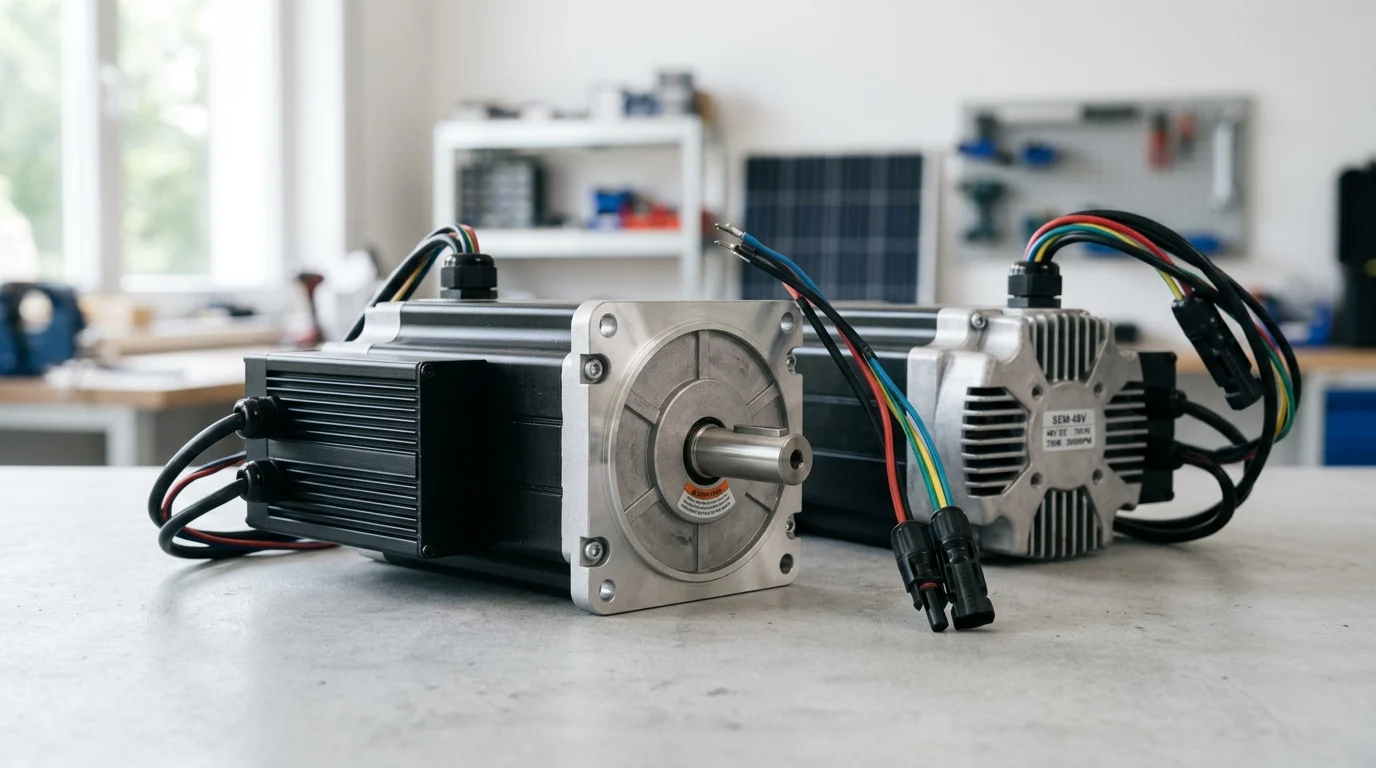
Introduction
Noise control in commercial buildings increasingly depends on motor technology, especially in HVAC, ventilation, and cooling systems that run for long hours near occupied spaces. Solar EC motors address this challenge by combining direct solar power with electronically commutated control, allowing equipment to operate with less vibration, smoother speed modulation, and lower acoustic output than many conventional AC designs. This article explains where the noise reduction comes from, why it matters for compliance and occupant comfort, and how these motors perform in real-world commercial applications, setting up a closer look at the mechanisms and design choices behind their quieter operation.
How Solar EC Motors Reduce Noise in Commercial Applications
Solar Electronically Commutated (EC) motors represent a significant leap in acoustic management for commercial infrastructure, integrating the energy independence of direct current (DC) photovoltaics with the precise, quiet control of solid-state stators. As urban density increases and building regulations tighten, mitigating noise pollution from HVAC arrays, cooling towers, and industrial ventilation systems has become a top priority for facility managers and mechanical engineers. Transitioning from traditional shaded-pole or AC induction motors to solar-powered EC variants frequently yields a baseline noise reduction of 10 to 15 dB(A) under partial loads, transforming the acoustic footprint of commercial properties.
Why low-noise performance matters
Acoustic comfort is no longer an optional luxury in commercial real estate; it is a stringent regulatory and tenant requirement. Organizations must adhere to strict indoor noise criteria, such as maintaining Noise Criterion (NC) ratings between NC-35 and NC-40 for open-plan offices and healthcare environments. When rooftop HVAC units or localized ventilation fans exceed these acoustic thresholds, the resulting low-frequency hum can cause severe acoustic fatigue, reducing worker productivity and tenant satisfaction. Solar EC motors mitigate this risk by eliminating the 60 Hz electrical hum characteristic of grid-tied AC motors, replacing it with a smoother, continuously variable operational profile that seamlessly matches the thermal load.
How lower noise emissions improve operations
Lower noise emissions directly translate into expanded operational flexibility and regulatory compliance. Facilities can operate heavy ventilation equipment during nighttime hours without violating local municipal noise ordinances, which typically cap exterior noise at 50 to 55 dB(A) at the property line. Furthermore, because solar EC motors run cooler and quieter at variable speeds, maintenance teams experience fewer vibration-induced structural failures. This reduction in mechanical resonance extends the mean time between failures (MTBF) of the surrounding ductwork and chassis components by up to 30,000 hours compared to legacy systems, ensuring operations remain uninterrupted and maintenance overhead is minimized.
What Makes Solar EC Motors Quieter Than Conventional Motors

The acoustic superiority of solar EC motors stems from their fundamental architecture, which replaces mechanical commutation with solid-state electronics. By operating on direct current—often fed directly from commercial solar arrays or integrated battery storage systems—these motors bypass the inherent acoustic penalties and magnetic pulsing associated with alternating current sine waves.
How electronic commutation reduces noise
Electronic commutation eliminates the physical friction, sparking, and audible scraping associated with carbon brushes in traditional DC motors. Instead, an onboard microprocessor utilizes Pulse Width Modulation (PWM) to dictate the firing sequence of the magnetic fields within the stator. By pushing the PWM switching frequency above 16 kHz—and routinely up to 20 kHz in premium models—engineers ensure that any residual electromagnetic switching noise falls completely outside the audible spectrum of human hearing. This precise, field-oriented control (FOC) minimizes torque ripple, a primary source of structural vibration and low-frequency mechanical noise that plagues older motor designs.
Which design factors affect acoustic performance
Beyond the commutation electronics, advanced mechanical design plays a critical role in acoustic damping. High-end solar EC motors utilize permanently lubricated, double-shielded ball bearings rated at ABEC 5 or higher, which drastically reduce rolling friction and high-pitched bearing whine. Additionally, the integration of aerodynamically optimized external rotors allows for smoother, less turbulent airflow over the motor housing. Engineers also utilize skewed stator slots and optimized magnetic air gaps—typically maintained at highly rigid tolerances of 0.3 to 0.5 mm—to suppress cogging torque and prevent the housing from acting as an acoustic amplifier.
What to compare in a motor evaluation table
When evaluating motor technologies for noise-sensitive deployments, procurement engineers must look beyond basic nameplate horsepower. A comprehensive motor evaluation table should benchmark acoustic emissions alongside electromechanical efficiency and expected lifecycle metrics to provide a clear picture of overall value.
| Motor Technology | Average Noise Level (dB(A)) | Typical Peak Efficiency (%) | Expected Lifespan (Hours) | Torque Ripple |
|---|---|---|---|---|
| AC Induction | 55 – 65 | 60% – 70% | 20,000 – 30,000 | High |
| Brushed DC | 60 – 75 | 50% – 65% | 5,000 – 10,000 | Moderate |
| Solar EC Motor | 40 – 45 | 85% – 90%+ | 50,000 – 80,000 | Very Low |
Analyzing these parameters reveals that solar EC motors not only operate up to 20 dB(A) quieter than their AC counterparts but also double the operational lifespan. This makes the acoustic upgrade inherently tied to long-term mechanical reliability and energy efficiency.
How to Evaluate Solar EC Motors for Noise-Sensitive Applications
Selecting the appropriate solar EC motor requires translating qualitative acoustic goals into quantifiable engineering specifications. Because human noise perception is logarithmic, even a 3 dB(A) reduction represents a halving of sound energy. Consequently, precise specification and rigorous testing are critical for achieving the desired environmental outcomes in sensitive commercial spaces.
Which specifications matter most
The most critical specifications for acoustic evaluation are the Sound Power Level (LwA) and the Sound Pressure Level (LpA). LwA measures the total acoustic energy emitted by the motor itself, independent of the surrounding environment, whereas LpA measures the sound pressure at a specific distance (typically standardized at 1 meter or 3 meters). Additionally, engineers must evaluate the vibration severity grade; motors intended for ultra-quiet environments should meet a vibration velocity of less than 1.5 mm/s RMS at nominal operating speed. Thermal performance also indirectly impacts noise, as motors capable of operating continuously at 40°C without requiring secondary, high-RPM cooling fans eliminate an entirely separate noise vector.
How requirements vary by application
Application environments dictate the stringency of these acoustic parameters. In medical facilities, broadcast studios, or high-end hospitality venues, motors integrated into ventilation systems must strictly adhere to an LpA of 30 to 35 dB(A) at a 1-meter distance to prevent interference with sensitive equipment or human recovery. Conversely, in commercial edge data centers utilizing solar-powered cooling arrays, the primary objective is moving massive volumes of air to maintain server temperatures. In these environments, an LpA threshold of 60 to 65 dB(A) is generally acceptable, provided the noise spectrum is broadband and lacks distinct tonal spikes that cause acoustic fatigue among IT personnel.
How to validate low-noise performance
Validating these specifications requires rigorous empirical testing rather than relying solely on optimal-condition manufacturer datasheets. Procurement teams should mandate certified test reports conducted in hemi-anechoic or fully anechoic chambers in strict accordance with ISO 3744 or ISO 3745 standards. Furthermore, validation should include spectral analysis using 1/3 octave band data to ensure the motor does not emit specific resonant frequencies. Identifying these frequencies is vital, as a motor that appears quiet in isolation can induce severe harmonic resonance when mounted to thin sheet metal chassis or rigid HVAC ductwork.
Compliance, Integration, and Supply Chain Risks
Deploying solar EC motors at scale introduces complexities related to regulatory compliance, electrical integration, and supply chain stability. Failing to account for these risks can compromise both the acoustic performance of the final product and the financial timeline of the commercial deployment.
Which standards and certifications apply
Commercial solar EC motors must comply with a stringent matrix of international standards. In North America, UL 1004-7 specifically addresses the safety and performance of electronically commutated motors. For acoustic and environmental compliance, CE marking and adherence to the ErP (Energy-related Products) Directive 2015/1253 are mandatory in European markets. Furthermore, facilities enforcing strict acoustic profiles often require motors to meet specific IEC 60034-9 limits for rotating electrical machines, ensuring baseline noise emissions do not exceed 60 dB(A) for standard industrial form factors under maximum load.
How integration and power conditions affect noise
The acoustic performance of an EC motor is highly dependent on the quality of its DC power supply. When integrated with commercial solar arrays, Maximum Power Point Tracking (MPPT) charge controllers and solar inverters can introduce high-frequency voltage ripple onto the DC bus. If the ripple exceeds 5% of the nominal voltage (e.g., fluctuating more than 2.4V on a 48V system), it can destabilize the motor’s internal PWM controller. This electrical instability frequently manifests as audible electromagnetic whining and increased torque pulsation. Implementing proper filtering capacitors, utilizing shielded cabling, and maintaining stable DC bus voltages (commonly 24V, 48V, or 310V) are essential steps to isolate the motor from power anomalies.
How to assess suppliers and product consistency
Supply chain consistency is paramount for maintaining acoustic standards across an entire product line or facility deployment. Evaluating suppliers requires auditing their end-of-line (EOL) testing procedures to ensure every manufactured motor undergoes automated vibration and acoustic checks before shipping. Industry-leading suppliers maintain a defect rate of less than 500 Parts Per Million (PPM) and enforce strict tolerances on bearing installation and rotor balancing. Buyers should also negotiate Minimum Order Quantities (MOQs)—typically ranging from 100 to 500 units for custom-tuned, low-noise EC motors—while securing secondary sourcing agreements to mitigate geopolitical or logistical disruptions.
Building the Business Case for Solar EC Motors

While the initial capital expenditure for solar EC motors is higher than that of standard AC induction motors, the financial and strategic justification becomes robust when factoring in operational expenditure reductions, corporate ESG (Environmental, Social, and Governance) goals, and acoustic compliance.
When the return on investment is strongest
The Return on Investment (ROI) accelerates most rapidly in applications characterized by high duty cycles and stringent noise regulations. Facilities operating ventilation or cooling systems for more than 4,000 hours annually see the most dramatic financial benefits. By drawing power directly from solar arrays and utilizing the 85% to 90% electromechanical efficiency of EC technology, operators can reduce grid energy consumption by up to 50%. When coupled with the avoidance of municipal fines for noise ordinance violations—which can exceed $1,000 per day in densely populated urban commercial zones—the payback period for the premium motor tier frequently drops to under 24 months.
How procurement choices balance cost and performance
Procurement leaders must balance upfront costs with long-term performance metrics. While a standard AC motor might cost significantly less at the point of purchase, the integrated electronics, superior bearings, and acoustic damping of a solar EC motor drastically alter the total cost of ownership over a typical five-year cycle.
| Cost Component | Standard AC Motor System | Premium Solar EC Motor System |
|---|---|---|
| Initial Unit Cost | $150 – $250 | $350 – $600 |
| Annual Energy Cost (Grid) | $400 (at $0.15/kWh) | $0 (Solar powered) |
| Acoustic Mitigation (Enclosures) | $300 – $500 per unit | $0 (Inherently quiet) |
| 5-Year Total Cost of Ownership | $2,450 – $2,750 | $350 – $600 (Excluding solar array CAPEX) |
By evaluating these lifecycle expenses, organizations can easily justify the initial premium of solar EC motors. The elimination of secondary acoustic enclosures, combined with the drastic reduction in ongoing energy and maintenance costs, solidifies the technology as a financially sound, future-proof investment for modern commercial infrastructure.
Key Takeaways
- The most important conclusions and rationale for Solar EC Motors
- Specs, compliance, and risk checks worth validating before you commit
- Practical next steps and caveats readers can apply immediately
Frequently Asked Questions
Why are Solar EC motors quieter than conventional AC motors?
They use electronic commutation and variable-speed control, which cuts 60 Hz hum, torque ripple, and vibration. In many commercial systems, this can reduce noise by about 10–15 dB(A) at partial load.
Where do Solar EC motors make the biggest noise-reduction impact?
They are especially effective in HVAC units, rooftop ventilation, cooling systems, and industrial fans where continuous operation and tenant comfort matter most.
What should I compare when selecting a low-noise Solar EC motor?
Check dB(A) rating, PWM frequency, bearing quality, torque ripple, efficiency, and lifespan. For commercial sites, also confirm compatibility with your PV microgrid or battery-backed system.
Do quieter Solar EC motors also reduce maintenance needs?
Usually yes. Lower vibration and cooler operation can reduce bearing wear, structural resonance, and duct or chassis stress, helping extend service intervals in commercial installations.