Introduction
Choosing a BLDC motor for industrial equipment is less about matching a nameplate and more about balancing torque, speed, duty cycle, control compatibility, and long-term operating cost. The right choice affects efficiency, thermal performance, positioning accuracy, maintenance intervals, and uptime across demanding production environments. This guide outlines the key selection criteria engineers and buyers should evaluate, from load characteristics and peak-demand margins to electronic commutation requirements and service life expectations. With that foundation, the following sections show how to compare motor options against real application needs and avoid oversizing, instability, or premature failure.
Why BLDC motor selection matters for industrial equipment performance
The specification of a Brushless DC (BLDC) motor dictates the fundamental reliability, energy consumption, and dynamic response of modern industrial equipment. Unlike their brushed counterparts, BLDC motors rely on electronic commutation, eliminating brush wear and allowing them to achieve operating efficiencies between 85% and 92%. In automated industrial environments, this efficiency translates directly into reduced thermal loads and lower lifecycle energy costs.
Selecting the correct BLDC motor requires an uncompromising evaluation of both mechanical output and electronic integration. A mismatched motor not only compromises equipment precision but also accelerates component fatigue, leading to costly unplanned downtime. For high-throughput industrial machinery, the motor selection process must align strictly with the application’s continuous and peak operational demands.
How should the opening frame BLDC motor selection?
Engineers must frame the BLDC motor selection process around Total Cost of Ownership (TCO) rather than focusing strictly on initial unit cost. Industrial applications often require continuous 24/7 operation, making the L10 bearing life—typically targeted at 40,000 to 50,000 hours for premium industrial motors—a critical metric. When establishing the initial framework, system architects should define the exact motion profile, evaluating whether the motor will operate primarily at a steady state or undergo rapid, high-frequency indexing.
Which industrial applications are most exposed to poor selection?
Applications characterized by high dynamic loads and strict synchronization requirements are severely exposed to poor motor selection. Automated Guided Vehicles (AGVs), for instance, demand high starting torque and precise low-speed control; a poorly specified motor with excessive cogging torque will cause jerky movements, jeopardizing navigation accuracy (often required to be within 0.1 degrees). Similarly, in continuous packaging lines running at 300 to 500 units per minute, an undersized BLDC motor will experience thermal runaway due to continuous operation above its rated RMS torque, leading to premature winding failure.
Which BLDC motor specifications determine industrial fit
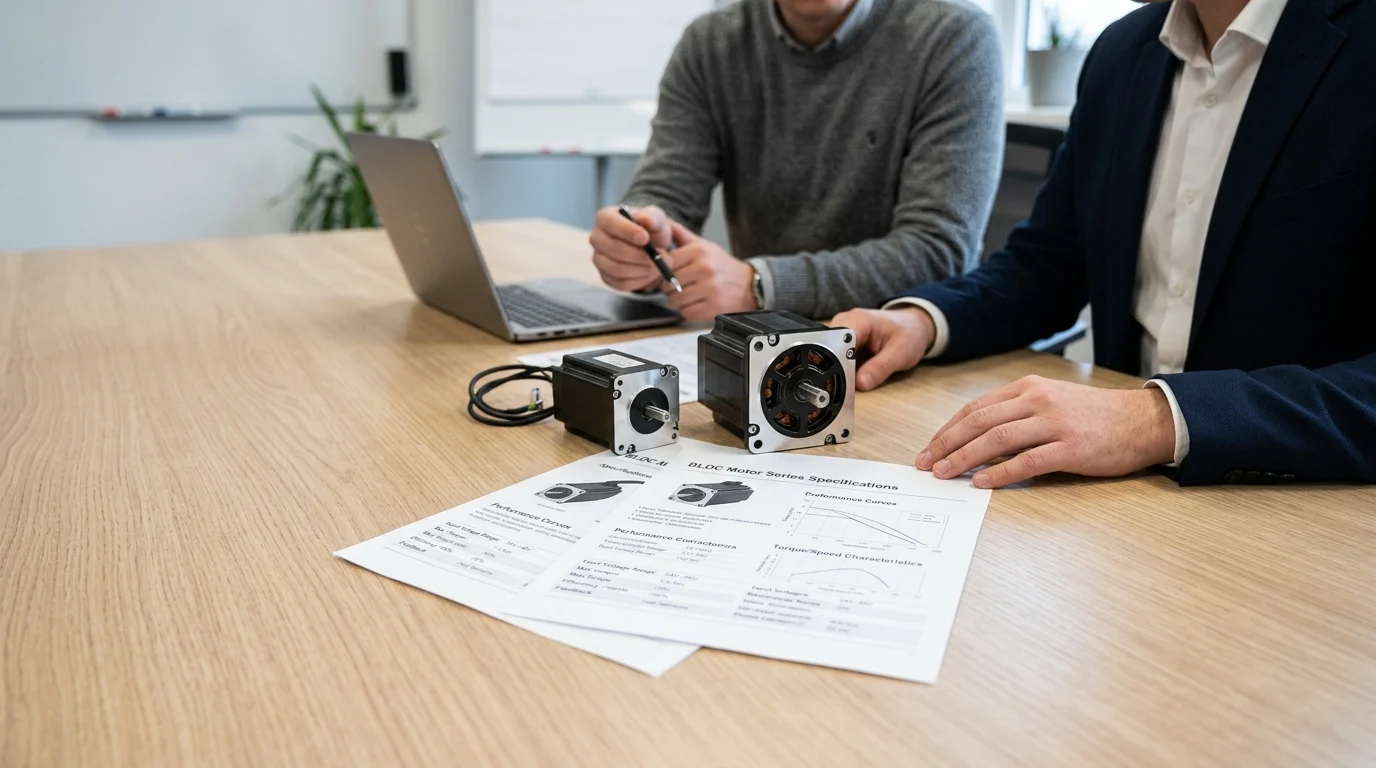
Translating mechanical system requirements into precise BLDC motor specifications is the most rigorous phase of the design cycle. Industrial fit is determined by a combination of torque capabilities, thermal limits, and the physical architecture of the motor, all of which must strictly align with the operational environment.
How should torque, speed, duty cycle, inertia, and load be evaluated?
The evaluation of torque and speed must differentiate between continuous (RMS) requirements and peak demands. A properly specified BLDC motor should handle peak torque demands of 200% to 300% of its nominal rating for short durations (typically 3 to 5 seconds) during acceleration or emergency braking. Duty cycle dictates the thermal dissipation needed; a high duty cycle requires a motor with a superior continuous torque rating. Furthermore, the load-to-motor inertia ratio must be carefully calculated. For high dynamic response in industrial automation, the inertia mismatch should ideally be kept below a 5:1 ratio to prevent control loop instability and excessive energy consumption during acceleration.
Which electrical, thermal, enclosure, and control-interface parameters matter most?
Electrical and thermal parameters dictate the survivability of the motor in harsh environments. Insulation class is paramount; Class F (155°C) is standard, but Class H (180°C) is highly recommended for high-load, enclosed industrial applications. The physical enclosure must match the environmental threat, requiring an IP65 rating for general dust and water jets, or IP67/IP69K for washdown environments in food and beverage processing. For control interfaces, the choice between sensorless commutation and sensored (Hall effect or absolute encoders) depends on low-speed requirements. Sensored motors are mandatory for applications requiring full torque at zero RPM.
What comparison table best contrasts inrunner vs. outrunner and other key choices?
The structural design of the motor—specifically whether the rotor is internal or external—fundamentally alters its performance characteristics. The following table contrasts the critical specifications of inrunner and outrunner BLDC motors for industrial integration:
| Feature/Specification | Inrunner BLDC Motor | Outrunner BLDC Motor |
|---|---|---|
| Rotor Position | Inside the stator | Outside the stator |
| Inertia | Low (allows rapid acceleration) | High (provides flywheel effect) |
| Speed Range | Up to 100,000+ RPM | Typically < 10,000 RPM |
| Torque Density | Moderate | High (at lower speeds) |
| Heat Dissipation | Excellent (stator attached to housing) | Moderate (stator is internal) |
| Best Industrial Fit | CNC spindles, high-speed robotics | Direct-drive conveyors, AGV wheels |
Selecting between these architectures requires mapping the exact speed-torque curve of the application against the motor’s capabilities, ensuring the continuous operating point falls well within the continuous operating zone of the selected motor.
How should industrial buyers compare BLDC motor architectures and suppli
Procurement and engineering teams must evaluate BLDC motor architectures alongside the capabilities of the manufacturing partner. A superior motor design on paper can easily fail in the field if the supplier lacks the quality control and supply chain stability required for industrial scale.
Which design trade-offs influence efficiency, noise, and service life?
Design trade-offs directly impact the efficiency, acoustic profile, and service life of the motor. Slotted stators offer high torque density but introduce cogging torque, which can disrupt smooth motion at low speeds. For high-precision applications, a slotless design reduces cogging torque to near zero, though it sacrifices some torque output. Acoustic noise is another critical trade-off; medical manufacturing and cleanroom environments often require motors operating below a 55 dB threshold, necessitating precision-balanced rotors and premium ABEC 5 or higher bearings, which inherently increase unit cost.
What supplier evaluation criteria matter most for custom BLDC motors?
When evaluating suppliers for custom or modified BLDC motors, quality assurance metrics and manufacturing certifications must be scrutinized. Industrial buyers should demand ISO 9001 and, where applicable, IATF 16949 certifications. Defect rates must be rigorously quantified; a world-class motor supplier should demonstrate a defect rate of fewer than 50 Parts Per Million (PPM). Furthermore, buyers must evaluate the supplier’s end-of-line testing capabilities, ensuring 100% of shipped units undergo automated testing for back EMF, phase resistance, and dielectric strength.
What comparison table should summarize price drivers, tooling, and lead times?
Understanding the cost structure and lead times associated with different levels of customization is essential for project planning. The table below summarizes the typical procurement drivers based on the level of motor customization:
| Sourcing Strategy | Relative Unit Price | Typical Tooling Cost | Prototyping Lead Time | Production Lead Time |
|---|---|---|---|---|
| Commercial Off-The-Shelf (COTS) | Baseline ($) | $0 | 1 – 2 weeks | 4 – 8 weeks |
| Modified Standard | $+15% to 30% | $500 – $2,500 | 3 – 5 weeks | 8 – 12 weeks |
| Fully Custom Architecture | $+50% to 100%+ | $10,000 – $50,000+ | 8 – 14 weeks | 16 – 24 weeks |
Industrial buyers must balance the engineering benefits of a fully custom motor against the extended 16- to 24-week production lead times and significant tooling investments, often finding that modified standard motors offer the optimal compromise for volumes under 5,000 units per year.
What compliance, integration, and validation steps reduce BLDC motor dep
Deploying BLDC motors into industrial equipment carries inherent risks related to electromagnetic compatibility, thermal management, and controller synchronization. A structured validation and compliance strategy is mandatory to prevent system failures and ensure regulatory adherence during final machine commissioning.
Which regulatory, safety, EMC, and environmental requirements should be checked?
Compliance with international regulatory and safety standards cannot be an afterthought in BLDC motor selection. Motors must meet CE and UL safety requirements, alongside RoHS for material compliance. In industrial settings, Electromagnetic Compatibility (EMC) is highly scrutinized. The motor and its drive must adhere to strict immunity and emissions standards, such as EN 61000-6-2 (immunity for industrial environments) and EN 61000-6-4 (emissions). Furthermore, high-pot (dielectric withstand) testing is critical; industrial motors are typically subjected to 1000V plus twice the rated voltage (1000V + 2*Un) for 60 seconds to guarantee insulation integrity under voltage spikes.
How should teams validate controller matching and thermal margins?
The interaction between the BLDC motor and the motor controller requires rigorous empirical validation. Engineers must match the motor’s phase inductance with the controller’s PWM switching frequency, which typically ranges from 10 kHz to 20 kHz. Too low a frequency can cause excessive current ripple and motor heating, while too high a frequency increases switching losses in the drive. Thermal margins must be validated by running the motor at its maximum continuous load until thermal equilibrium is reached. A robust industrial design dictates that the internal winding temperature should not exceed 80% of its absolute thermal limit under worst-case ambient conditions (e.g., maintaining 124°C on a 155°C Class F insulation system).
What step-by-step BLDC motor selection process moves from shortlist to final choice?
A disciplined, step-by-step selection process moves a project safely from a shortlist of motors to a finalized choice. First, engineers must extract the exact torque-speed profile from the mechanical load data. Second, they evaluate the motor constants (Kt for torque, Kv for speed) to filter candidates that meet the profile with a 20% safety margin. Third, the selected motor is paired with a compatible drive to simulate dynamic performance. Finally, hardware validation is conducted by procuring a small pilot run (typically 5 to 10 units) to perform accelerated life testing and verify thermal and EMC performance in the actual machine chassis.
How should decision-makers finalize the right BLDC motor selection

Finalizing the selection of a BLDC motor requires synthesizing mechanical specifications, electrical constraints, and commercial realities into a coherent procurement strategy. Decision-makers must pivot from purely technical evaluations to holistic risk management, ensuring the chosen motor delivers both performance and long-term supply chain viability.
Which decision matrix best prioritizes performance, compliance, and cost?
A weighted decision matrix is the most effective tool for prioritizing conflicting requirements. For heavy industrial equipment, a common weighting distribution allocates 40% to technical performance (torque density, thermal limits, and efficiency), 30% to reliability and compliance (IP ratings, bearing life, and EMC certifications), and 30% to commercial factors (unit cost at target volumes, lead times, and supplier PPM defect rates). This matrix becomes particularly crucial when scaling production from initial pilot runs to high-volume manufacturing of 10,000 or more units per year, where minor unit cost savings must not override long-term reliability metrics.
How should the conclusion translate BLDC motor selection criteria into action?
Translating BLDC motor selection criteria into action requires bridging the gap between mechanical engineering, electrical design, and procurement. Cross-functional teams must lock in the critical specifications—such as the exact torque-speed curve, inertia ratio, and thermal class—before freezing the mechanical envelope of the equipment. As industrial automation increasingly demands integrated motor-drives and IoT-ready nodes for predictive maintenance, the final selection must not only solve today’s motion control challenges but also provide the data bandwidth and reliability required for next-generation smart manufacturing.
Key Takeaways
- The most important conclusions and rationale for BLDC motor
- Specs, compliance, and risk checks worth validating before you commit
- Practical next steps and caveats readers can apply immediately
Frequently Asked Questions
What should I prioritize first when selecting a BLDC motor for industrial equipment?
Start with the application’s duty cycle, torque, speed, and thermal limits. For 24/7 use, focus on continuous RMS torque and bearing life, not just purchase price.
How do I know if a BLDC motor is undersized for my machine?
If it runs above rated RMS torque, overheats, or causes unstable motion under load, it is likely undersized. Check both peak and continuous requirements.
When should I choose a sensored BLDC motor instead of sensorless?
Choose sensored control when you need full torque at zero RPM, precise low-speed control, or smooth startup in high-load industrial systems.
What enclosure rating is suitable for harsh industrial environments?
Use IP65 for dust and water jets, and IP67 or IP69K for washdown environments such as food and beverage processing.
Is inrunner or outrunner BLDC better for industrial equipment?
Use inrunner motors for higher speed and fast acceleration. Choose outrunners when you need higher torque at lower speeds.