Quick Answer:
Retrofitting existing industrial ventilation systems with solar fan installations reduces facility energy consumption by 60–80% during daylight hours, with typical payback periods of 3–7 years depending on electricity rates, operating hours, and installation conditions. Solar industrial fans utilize photovoltaic direct-drive motors achieving 90–96% motor efficiency, compared to 75–90% for traditional AC induction motors. A single 48-inch solar fan operating 2,500 hours annually eliminates approximately $700–$1,300 in electricity costs and offsets 2–3 metric tons of CO2 per year. For facilities with existing ventilation infrastructure, hybrid retrofit approaches combining solar fans with traditional systems maintain 24/7 coverage while progressively reducing grid dependency.
Key Takeaways:
- Solar retrofit reduces ventilation energy costs by 60–80% during daylight operation
- Motor efficiency reaches 90–96% with photovoltaic direct-drive technology
- Annual electricity savings of $700–$1,300 per fan depending on utility rates
- 3–7 year payback period; 20–25 year system lifespan
- Hybrid configurations enable 24/7 ventilation with daytime solar coverage
- Typical retrofit requires 300–500 W solar panel capacity per fan unit
Introduction: Why Industrial Ventilation Retrofits Matter Now
Industrial facilities consume approximately 30–40% of total building energy on ventilation and air circulation systems, making ventilation retrofit one of the highest-impact efficiency opportunities in manufacturing environments. As electricity prices rise an average of 3–5% annually across major industrial regions and corporate sustainability mandates tighten, facility managers face mounting pressure to reduce operational energy costs while meeting environmental compliance targets.Traditional industrial ventilation systems—belt-driven or direct-drive fans connected to electrical grids—represent decades-old technology with inherent efficiency limitations. These systems continuously draw power regardless of actual ventilation demand, creating unnecessary consumption during partial-load operations and overnight periods when facilities operate at reduced capacity.
Solar fan retrofit addresses this inefficiency directly. By replacing or supplementing grid-powered fans with photovoltaic direct-drive units, facilities convert a constant energy cost into a near-zero marginal cost during daylight hours. The International Energy Agency (IEA) reported in 2024 that industrial motor systems account for approximately 45% of global electricity consumption, with ventilation fans representing the second-largest category after pump systems.
Understanding Solar Industrial Fan Technology
How Photovoltaic Direct-Drive Systems Work
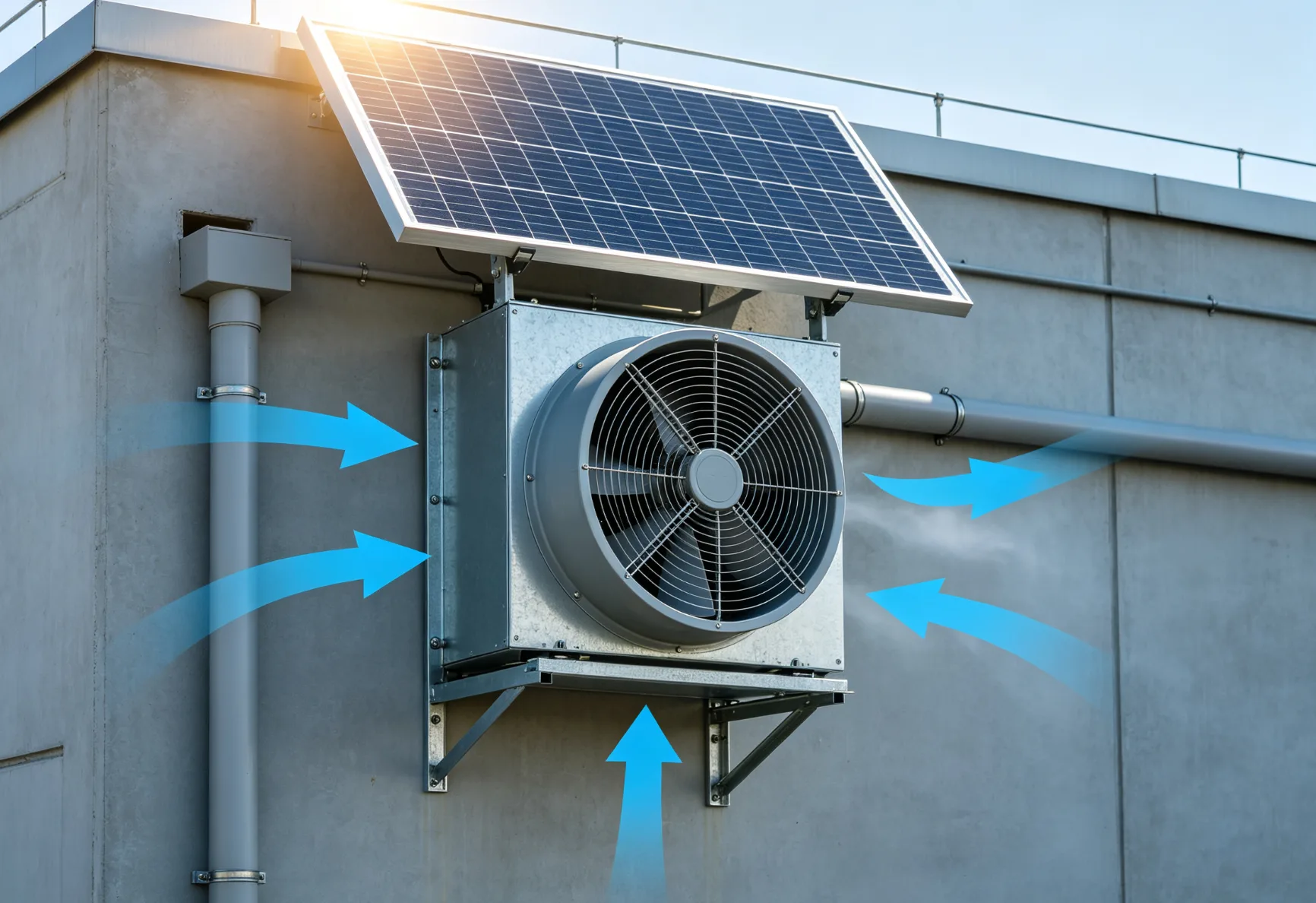
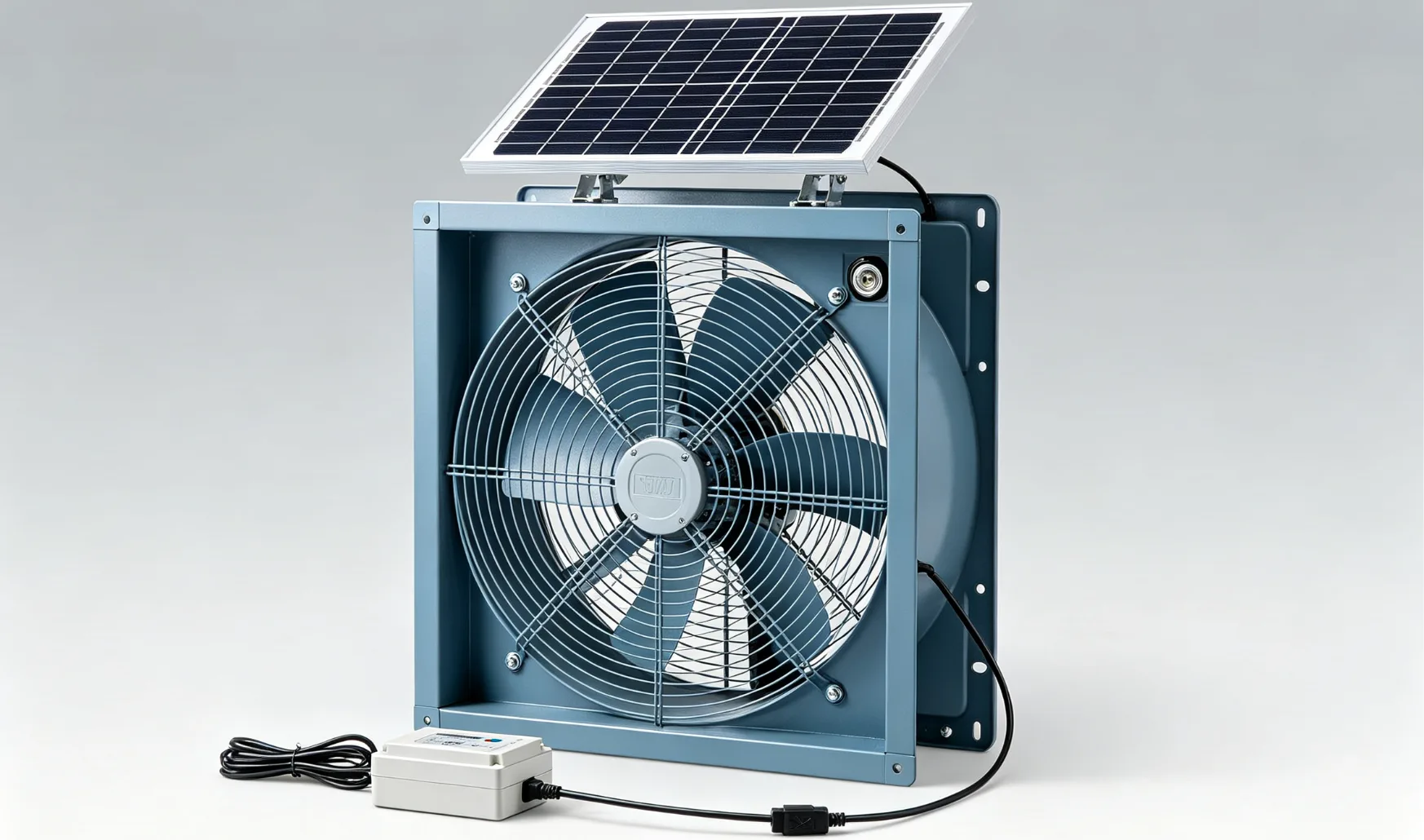
Solar industrial fans convert sunlight directly into rotational mechanical energy through a streamlined power chain: photovoltaic panels generate DC electricity, which feeds a brushless DC motor that drives the fan blade without intermediate mechanical transmission stages. This direct-drive configuration eliminates efficiency losses inherent in traditional belt-drive systems, where friction and slippage consume 5–15% of transmitted power.
The motor technology in quality solar industrial fans relies on permanent magnet synchronous motor (PMSM) or brushless DC (BLDC) designs, achieving nominal efficiencies of 90–96% across the operating speed range. In contrast, premium traditional AC induction motors—the most efficient conventional option—typically deliver 85–90% efficiency under full load, with performance degrading significantly under partial load conditions common in variable-demand ventilation scenarios.
Key Technical Specifications
| Parameter | Solar Direct-Drive Fan | Traditional Belt-Drive Fan |
| Motor Efficiency | 90–96% | 75–90% |
| System Efficiency (with transmission) | 88–93% | 65–82% |
| Operating Temperature Range | -20C to +55C | -20C to +50C |
| Maintenance Interval | 12–24 months | 6–12 months |
| Design Lifespan | 20–25 years | 15–20 years |
| Daily Operating Cost (electricity) | $0 (daylight) | $2.20–$4.10 |
| Annual Operating Cost | $50–200 | $800–$1,500 |
Fan blade design significantly impacts system performance. Most solar industrial fans use axial-flow blades optimized for high-volume, low-pressure air movement typical in warehouse and workshop environments. For facilities requiring higher static pressure—such as those with ductwork systems—centrifugal fan configurations with solar-compatible motors provide the necessary performance characteristics.
Intelligent Control Integration
Modern solar ventilation systems integrate ambient sensors and microprocessor controllers that modulate fan speed based on real-time conditions. Temperature and humidity sensors feed data to control algorithms that adjust airflow to match actual ventilation demand rather than operating at fixed speeds regardless of conditions.
The US Department of Energy’s Advanced Manufacturing Office notes that variable-speed ventilation—when properly controlled by demand-based sensors—can reduce energy consumption an additional 30–50% compared to constant-speed operation. Solar fans with integrated intelligent control systems capture both the efficiency gains from direct-drive technology and the additional savings from demand-responsive operation.
Comparing Traditional and Solar Industrial Ventilation
Energy Efficiency and Operating Costs
The most quantifiable advantage of solar industrial fans is the elimination of electricity costs during daylight operation. For a typical 48-inch industrial fan operating 10 hours daily at $0.12/kWh, annual electricity costs reach approximately $1,095—comparable to the maintenance costs of traditional systems over the same period.
Solar industrial fans operating in equivalent conditions generate zero electricity cost during daylight hours. A facility that operates 8–10 hours during daylight can achieve 70–90% reduction in ventilation electricity costs during those operational periods. For facilities with solar battery storage or grid-tie capability, nighttime operation can be managed through backup systems or limited traditional fan operation.
Consider a 50,000 square meter warehouse in the southwestern United States operating 260 days annually, 10 hours per day, with 12 industrial fans providing ventilation. Annual electricity cost for traditional fans: approximately $15,000–$18,000. Annual electricity cost after solar retrofit: approximately $1,500–$3,000—a net savings of $12,000–$15,000 per year.
NREL’s 2025 Solar Industry Update indicates that installed costs for commercial-scale solar ventilation systems have declined to $1.80–$2.50 per watt in major markets, making payback periods increasingly competitive with other efficiency investments.
Reliability and Maintenance Comparison
Traditional industrial fans require regular belt replacement (typically every 6–12 months under continuous operation), motor bearing lubrication, and periodic alignment corrections. These maintenance requirements create both direct costs (parts and labor) and indirect costs (production disruption during maintenance windows).
Solar direct-drive fans eliminate belt and gearbox components entirely, reducing the wearing parts list to bearings and seals in the motor assembly. Quality solar fans specify maintenance intervals of 12–24 months for basic inspection and cleaning—primarily photovoltaic panel washing and electrical connection verification.The simplified mechanical design contributes to the longer design life of solar systems (20–25 years) compared to traditional fans (15–20 years). Motor bearing life in BLDC motors typically exceeds 50,000 operating hours under rated conditions, and sealed motor housings protect internal components from dust and moisture ingress common in industrial environments.
Performance Under Challenging Conditions
Solar fans perform best under direct sunlight, but panel efficiency decreases approximately 0.3–0.5% per degree Celsius above 25C ambient temperature. In extremely hot climates, panel surface temperatures on rooftops can reach 65–75C, reducing conversion efficiency by 12–18% from nominal ratings. This characteristic means solar fan output correlates inversely with cooling demand—a consideration for facilities in high-temperature regions.
Cold climate operation presents minimal challenges. In fact, photovoltaic panels operate more efficiently at cooler temperatures than at high temperatures, though snowfall can reduce available irradiance significantly. Panel tilting angles and ground clearance must account for local snowfall patterns to maintain energy generation during winter months.
Energy Savings Analysis: Quantifying the Retrofit Opportunity
Payback Period Calculations
Retrofit investment evaluation requires systematic comparison of incremental costs against projected savings over the system lifetime. The following framework applies to facilities replacing existing traditional fans with solar equivalents.
Incremental capital cost of solar retrofit versus traditional replacement: approximately $1,500–$2,500 per fan unit for equivalent airflow capacity (solar panels, controller, mounting hardware versus new traditional motor and belt system).
Annual operating savings: electricity cost elimination ($700–$1,300 per fan-year) plus maintenance cost reduction ($200–$400 per fan-year), totaling $900–$1,700 annual savings per retrofitted unit.
Simple payback period: 1.5–2.5 years based on capital savings alone. However, this calculation omits the residual value of existing traditional fans that would require replacement anyway, and the time-value of the capital invested.A more accurate assessment uses net present value (NPV) analysis over a 15-year horizon. Assuming 4% annual electricity price escalation—a conservative estimate based on historical utility rate trends—a solar fan with $1,500 incremental cost and $1,200 annual first-year savings yields a 15-year NPV of approximately $8,500–$12,000 at an 8% discount rate. This represents a 550–800% return on the incremental investment.
Carbon Emission Reduction
Beyond financial returns, solar ventilation retrofits deliver measurable carbon reduction. A 48-inch solar fan operating 2,500 hours annually offsets approximately 2.3 metric tons of CO2 per year, assuming a grid emission factor of 0.92 kg CO2/kWh (US average grid mix). Facilities with solar-heavy or renewable grid profiles can achieve proportionally greater emission reductions.
For facilities pursuing third-party sustainability certifications—such as ISO 14001 Environmental Management or LEED Operations and Maintenance—solar ventilation retrofits provide verifiable emission reduction data supporting certification documentation. The International Organization for Standardization maintains ISO 14064 standards for greenhouse gas accounting applicable to facility-level emission reduction claims.
Total Cost of Ownership: 20-Year Comparison
| Cost Category | Traditional Fan (20 years) | Solar Fan Retrofit (20 years) |
| Initial Capital | $800–$1,200 | $2,500–$4,000 |
| Electricity (20 years) | $16,000–$30,000 | $1,000–$4,000 |
| Maintenance (20 years) | $4,000–$8,000 | $1,500–$3,000 |
| Replacement (Year 10–15) | $600–$1,000 | $0–$800 |
| Total Cost of Ownership | $21,400–$40,200 | $5,000–$11,800 |
| Net Savings | $14,000–$30,000 | |
Annual operating cost reduction from solar retrofit typically ranges from $800–$1,700 per fan, with higher savings in regions with elevated electricity rates or longer daylight operating hours.
Application Scenarios: When Solar Retrofit Delivers Maximum Value
High-Bay Warehouses and Distribution Centers
Facilities with substantial roof space and high daylight exposure represent prime candidates for solar ventilation retrofit. A typical 15-meter-high warehouse receives 400–600 W/m2 of solar irradiance at peak midday conditions in mid-latitude locations. A single 400 W solar panel array generates sufficient power for a mid-sized industrial fan during peak sun hours.
Distribution centers operating primarily during daytime shifts (6:00 AM to 6:00 PM) align naturally with peak solar availability. For these facilities, solar ventilation can provide 80–100% of daily ventilation energy requirements without battery storage, minimizing system complexity and capital requirements.
Explore our solar industrial fan air circulation systems designed specifically for warehouse and distribution center applications with high mounting heights and large volumetric airflow requirements.
Manufacturing Facilities with Heat Load
Facilities generating significant process heat—metalworking, plastics processing, coating operations—require robust ventilation to maintain worker comfort and product quality. These applications typically demand high airflow volumes (10,000–25,000 CFM per fan unit) and benefit from the intelligent control capabilities of modern solar systems.
The correlation between high heat load (high ventilation demand) and high solar availability (maximum cooling effect from ventilation) makes industrial kitchens, forge shops, and coating plants particularly suitable applications. Ventilation systems operating during peak daylight hours can contribute to facility cooling loads through convective heat removal while generating the solar power that drives them.
Agricultural Buildings
Greenhouses, livestock facilities, and agricultural processing buildings frequently require ventilation that coincides with daytime operation patterns. Crop storage facilities need temperature and humidity control during daylight hours when solar heat gain is highest. Livestock facilities require ventilation to manage heat stress in animals during warm periods.
Agricultural facilities often have unique mounting conditions—open truss structures, gutter-side installations, polycarbonate panel surfaces—that require custom mounting solutions. Solar fan manufacturers offering agricultural-specific product lines typically provide flexible mounting hardware compatible with common agricultural building designs.
Retrofit Constraints: When Solar May Not Suit
Facilities requiring 24/7 continuous ventilation—such as pharmaceutical manufacturing clean rooms, food processing operations with constant temperature requirements, or data centers—cannot rely solely on solar power. For these applications, hybrid configurations or grid-connected solar systems with battery backup are necessary.
Locations with frequent extended cloud cover, significant shading from adjacent structures, or latitudes above 50 degrees (where daylight hours vary dramatically seasonally) may find solar ventilation economics less favorable. A minimum of 4–5 peak sun hours daily is generally required for economic solar ventilation viability.
Facilities with insufficient structural capacity to support panel mounting may require structural reinforcement before solar installation. A typical solar panel array weighs 15–25 kg/m2, and mounting structures add additional load. Structural engineering assessment is a standard component of solar retrofit project scoping.
Retrofitting vs. New Installation: Decision Framework
Evaluating Existing Ventilation Infrastructure
The retrofit decision hinges on the condition and remaining useful life of existing ventilation equipment. Fans less than 8–10 years old with well-documented maintenance records may have significant remaining service life, making full replacement economically questionable. In these cases, hybrid approaches—adding solar units to supplement rather than replace existing fans—preserve capital while capturing partial energy savings.
Fans exceeding 12–15 years of age approaching end-of-service life present clearer retrofit economics. Replacing aged traditional fans with solar equivalents eliminates both the imminent capital requirement for traditional replacement and future electricity costs, doubling the financial benefit of the investment.
Hybrid Configuration Options
Facilities needing continuous ventilation can implement hybrid configurations that combine solar and traditional systems:
- Solar-primary designs install solar fans as the primary ventilation source for daytime operation, with traditional fans retained for nighttime and extended low-sun periods. This approach requires minimal changes to existing electrical infrastructure while capturing 60–80% of potential energy savings.
- Expanded solar coverage uses capital freed from eliminated electricity costs to progressively expand solar capacity over multiple budget cycles. A facility might retrofit 30% of ventilation capacity in year one, using savings to fund additional retrofits in subsequent years.
- Intelligent microgrid integration connects all ventilation assets—solar and traditional—under a central control system that optimizes operational mode based on real-time conditions. The ParaFlow MicroGrid systems developed by EternalMaxx represent this integration approach, dynamically directing solar power to ventilation loads when available and switching to grid supply when necessary.
Learn more about intelligent microgrid integration approaches for industrial solar installations that enable progressive grid dependency reduction across facility ventilation portfolios.
Implementation Guide: Retrofitting Your Facility
Step 1: Site Assessment and Shading Analysis
Professional solar retrofit projects begin with detailed site assessment covering structural evaluation, shading analysis, and electrical infrastructure review. Shading analysis uses solar path calculations specific to the facility location to identify optimal panel placement and quantify annual solar access.
Panel placement should maximize irradiance exposure during peak ventilation demand hours—typically mid-morning through late afternoon for facilities with standard daytime operating schedules. Trees, adjacent buildings, rooftop equipment, and structural members cast shadows that reduce panel output in predictable seasonal patterns.
Step 2: System Sizing and Specification
Sizing solar ventilation systems requires matching panel array capacity to fan power requirements while accounting for local solar resource availability. A fan requiring 400 W of mechanical power, operating in a location receiving 5 peak sun hours daily, requires approximately 600–700 W of panel capacity (accounting for panel efficiency and system losses).
Specification should include motor efficiency ratings, controller functionality, panel technology (monocrystalline typically offers 3–5% higher efficiency than polycrystalline in commercial applications), and warranty terms. Quality solar fans carry 5–10 year warranties on motors and panels, with panel output guaranteed to 80% of rated capacity after 25 years.
Step 3: Installation and Commissioning
Professional installation ensures optimal performance and maintains warranty coverage. Mounting systems must be structurally rated for wind loads, with appropriate flashing and waterproofing to prevent roof leaks. Electrical connections should be made using weatherproof enclosures and appropriate conduit.
Commissioning includes performance verification under various irradiance conditions, controller function testing, and establishment of monitoring protocols. Documentation of as-installed performance supports ongoing optimization and return-on-investment tracking.
Step 4: Monitoring and Optimization
Modern solar ventilation systems include monitoring capabilities that track energy generation, fan runtime, and operational status. Regular monitoring identifies performance degradation—such as reduced panel output from soiling or connection issues—before significant energy losses accumulate.
Quarterly panel cleaning in dusty industrial environments maintains 95%+ of rated panel output. In rural or low-dust settings, annual cleaning may be sufficient. Monitoring data quantifies cleaning impact and schedules maintenance interventions optimally.
Frequently Asked Questions
How much does a complete solar industrial fan retrofit cost?
A complete solar industrial fan retrofit—including panels, fan unit, controller, mounting hardware, and professional installation—typically ranges from $2,500 to $4,500 per fan unit for equivalent airflow capacity compared to traditional systems. Battery backup systems add $800–$1,500 per unit. For a 10-fan facility, total project costs typically range from $25,000 to $45,000 before applicable incentives or tax credits.
Can solar fans provide sufficient ventilation for large industrial spaces?
Solar industrial fans are available in capacities ranging from 2,000 CFM to over 30,000 CFM per unit. Large facilities requiring high air volumes typically install multiple units sized to meet peak ventilation demand. For spaces exceeding 100,000 cubic meters, consult with solar ventilation engineers to specify a properly designed multi-unit system.
What maintenance does a solar ventilation system require?
Annual maintenance includes panel cleaning (more frequent in dusty environments), electrical connection inspection, and controller function verification. Unlike traditional fans, solar systems require no belt replacement or motor lubrication. Total annual maintenance cost typically ranges from $100–$300 per unit, compared to $200–$400 for traditional systems.
How do solar fans perform in winter and cloudy conditions?
Solar fans continue operating at reduced capacity during cloudy periods, with output proportional to available irradiance. Battery storage enables continuous operation during extended low-sun periods. Winter performance is typically strong in cold climates, as panel efficiency increases at lower temperatures, offsetting reduced daylight hours.
What structural requirements must my facility meet for solar fan installation?
Roof or mounting structures must support panel array weight (typically 20–35 kg/m2 including mounting), resist wind loads appropriate to the installation location, and provide suitable sun exposure. A structural engineering assessment is standard practice in solar retrofit project scoping to identify any reinforcement requirements before installation proceeds.
Are there government incentives for industrial solar ventilation retrofits?
Incentive availability varies significantly by jurisdiction. The US federal Investment Tax Credit (ITC) currently provides 30% of installed solar system cost as a tax credit for commercial installations through 2032. Many states offer additional incentives. European facilities may access programs through national energy agencies. Check with local solar installers or energy consultants for jurisdiction-specific incentive availability.
How long does the complete retrofit installation process take?
A typical industrial solar ventilation retrofit—site assessment through commissioning—spans 6–10 weeks for projects involving 5–15 fan units. Larger projects or those requiring structural modifications may extend to 12–16 weeks. The physical installation work itself typically requires 2–5 days per fan unit depending on mounting complexity and electrical integration requirements.