1. Background
According to authoritative industry statistics, as of 2025, the global number of swimming pools has exceeded 26 million, with residential pools accounting for over 65%. The scale of commercial pools (such as those in hotels and fitness clubs) and public pools is also continuously expanding amid the growing demand for leisure and fitness.
Against this large base, the AC induction motors commonly used in traditional pool circulation pumps have exposed inherent drawbacks like high energy consumption, loud noise, and poor adjustability, struggling to meet the modern requirements for green energy efficiency and intelligent operation & maintenance in swimming pools.
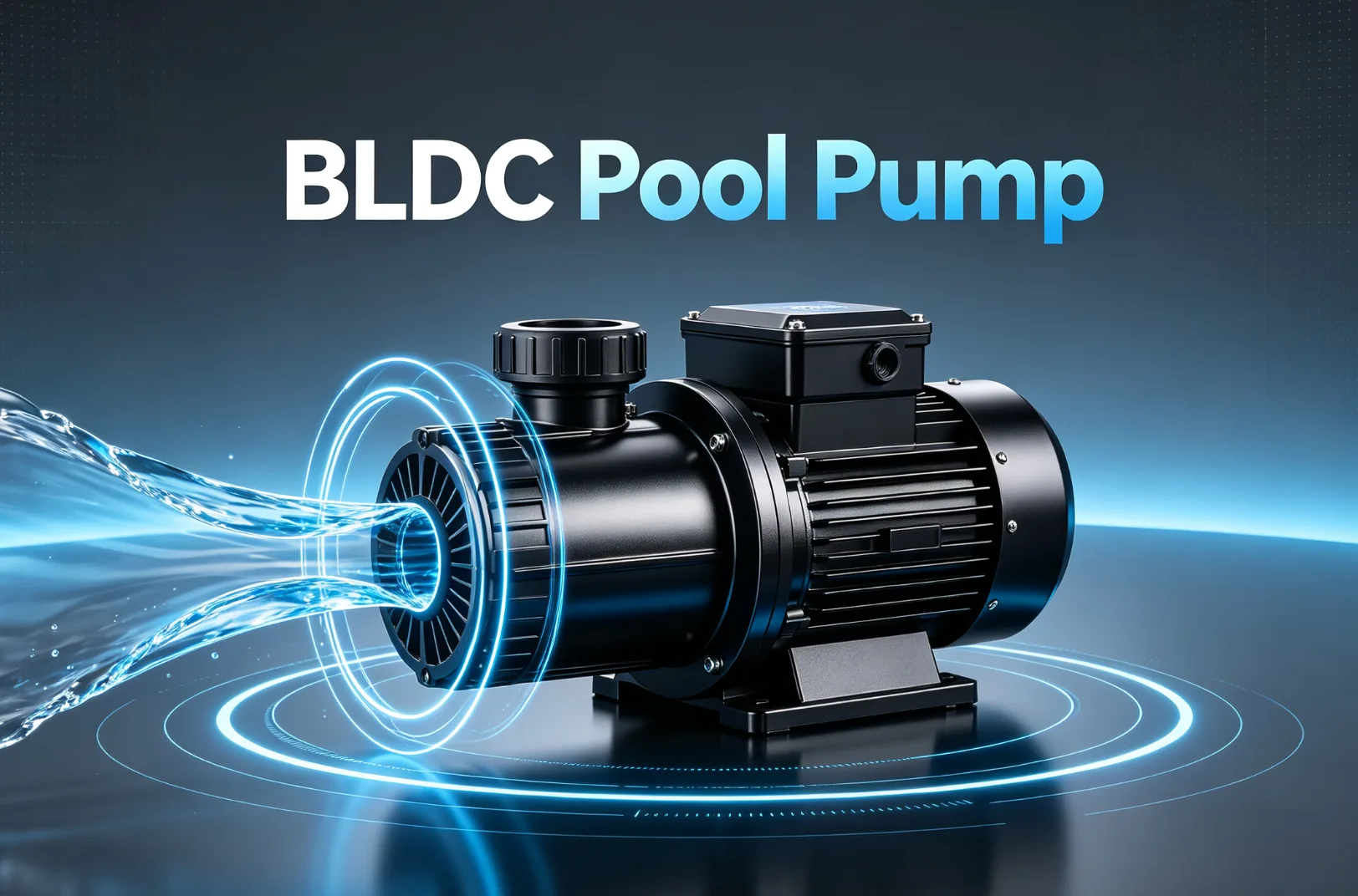
In this context, pool circulation pumps equipped with BLDC (Brushless DC) motors have gradually replaced traditional equipment by virtue of their superior technical characteristics, becoming the mainstream choice for the operation and maintenance of residential, commercial, and public swimming pools. This article will mainly introduce the core advantages of BLDC motor circulation pumps and the expansion of smart solar PV pool solutions, bringing users more energy-efficient and high-quality experiences.
2. Core Technical Advantages of BLDC Pool Pumps
BLDC motors replace mechanical commutation with electronic commutation, optimized for pool circulation conditions, offering four key advantages over traditional AC pumps:
2.1 Extreme Energy Efficiency
Pool pumps run 24/7, accounting for over 60% of total pool energy use. Traditional AC motors have 60%-75% efficiency, while BLDC motors reach over 90% with advanced magnetic circuit design and vector control. For a 100m³ pool, a 1.5kW AC pump consumes ~36 kWh/day (13,000 kWh/year), whereas a BLDC pump of the same power uses only ~20 kWh/day (7,300 kWh/year), slashing energy costs significantly.
2.2 Low Noise and Quiet Operation
Traditional AC pumps produce loud noise (65-80dB) from brush friction and mechanical issues, unsuitable for noise-sensitive areas like villa courtyards. BLDC motors eliminate brushes, using precision balancing and quiet bearings to keep noise at 40-55dB—quiet enough for nighttime operation without disturbing surroundings.
2.3 Precise Speed Regulation
Pool circulation requires dynamic flow adjustments based on seasons, user count, and pollution levels. Traditional fixed-speed AC pumps waste energy via valve throttling. BLDC motors support stepless speed regulation (0-3000rpm) with ±5% accuracy, using PID closed-loop control to auto-adjust based on water quality data (turbidity, residual chlorine), ensuring optimal performance year-round.
2.4 High Reliability
Pool environments are humid and corrosive (chlorine fumes), shortening traditional AC pumps’ lifespan to 3-5 years with annual maintenance. BLDC pumps feature IP68 fully sealed design, isolating stators and rotors to resist corrosion and dust. Without wear-prone brushes, their lifespan extends to 8-12 years, reducing maintenance costs by 80%.
3. Smart Solar Swimming Pool Solutions
BLDC pool pumps are evolving toward “smarter, greener, more integrated” operation, with solar PV expansion as a key path to zero-carbon maintenance. Traditional PV pool systems are costly, complex, and have long payback periods. Volcano Electric’s solutions address these issues with innovative technologies:
3.1 E-Hybrid AC/DC Solar Energizer Solution (Residential Pools)
Residential pool systems (circulation pump: 0.75-2.2kW; heat pump: ~3kW) use more energy during daytime (peak use) and less at night (energy-saving mode).
The E-Hybrid solution requires no energy storage, combining PV and grid power in real time. PV power is prioritized, with grid backup for shortages.
| Item | Parameter | Daytime (Avg.) | Nighttime (Avg.) |
| Runtime (h/day) | 8 | 6 | |
| Circulation Pump | Active Power (kW) | 2.0-2.2 | 0.6-1.2 |
| Traditional Syestem Energy Source | PV + Grid | Battery | |
| Smart Syestem Energy Source | PV | Grid | |
| Heat Pump | Active Power (kW) | 2.8-3.0 | 1.5-2.0 |
| Traditional Syestem Energy Source | Grid | Grid | |
| Smart Syestem Energy Source | PV+Grid | Grid |
Hybrid AC/DC Technology requires no energy storage, featuring real-time AC/DC hybrid complementation and prioritizing solar PV to maximize the use of green energy. The AC connection method of the heat pump and circulation pump system remains unchanged — even without the solar PV energy boost system, it is still a complete pool power and thermal system. Only a solar PV energy boost interface (independent from the AC power intake port) is added to the water pump motor to connect to solar PV panels. Built-in AC/DC conversion functionality enables E-Hybrid energy boost, where solar PV is prioritized and grid power supplements any insufficient power. This system boasts the lowest investment cost, simple configuration, and low complexity, with dual-energy parallel access ensuring reliable operation.
- When solar PV power is sufficient, it directly supplies power to the circulation pump, and surplus electricity powers the heat pump (with grid power supplementing any shortage for the heat pump).
- When solar PV power is insufficient, it only supplies power to the circulation pump, while the heat pump is powered by the grid.

In addition, the smart solar PV pool system supports remote control via a mobile APP. Users can check the operating status, adjust parameters at any time, and even preset operating modes for different time periods (such as high flow rate during the day and low flow rate at night), realizing intelligent and convenient management.
3.2 E-Router Microgrid (Large Pools)— Energy Flows Where It’s Needed
Both the circulation pump and heat pump adopt variable-frequency systems, with asynchronous power operation times. Without power microgrid technology, it is impossible to achieve free energy flow between the two devices, leading to insufficient utilization of solar energy.
By constructing a power microgrid, a solar PV interconnection system between the heat pump and circulation pump is formed. Solar energy can flow freely between the circulation pump and heat pump, directing power to where it is needed. This enables the construction of a smart solar PV pool system for large-scale swimming pools.
4. Conclusion
BLDC pool pumps have become the inevitable replacement for traditional pumps, delivering economic and social value across residential, commercial, and public pools. With intelligent technology integration and solar PV promotion, they are moving beyond energy savings to zero-carbon operation. For users, selecting suitable BLDC models and adopting solar solutions are key to reducing costs and enhancing experiences.