Commercial enterprises are increasingly adopting solar-powered EC motors to mitigate rising electricity costs and enhance operational sustainability. This guide evaluates the financial and technical advantages of integrating solar-powered EC motors into industrial systems, specifically focusing on energy efficiency and long-term return on investment (ROI).
Defining Solar-Powered EC Motors
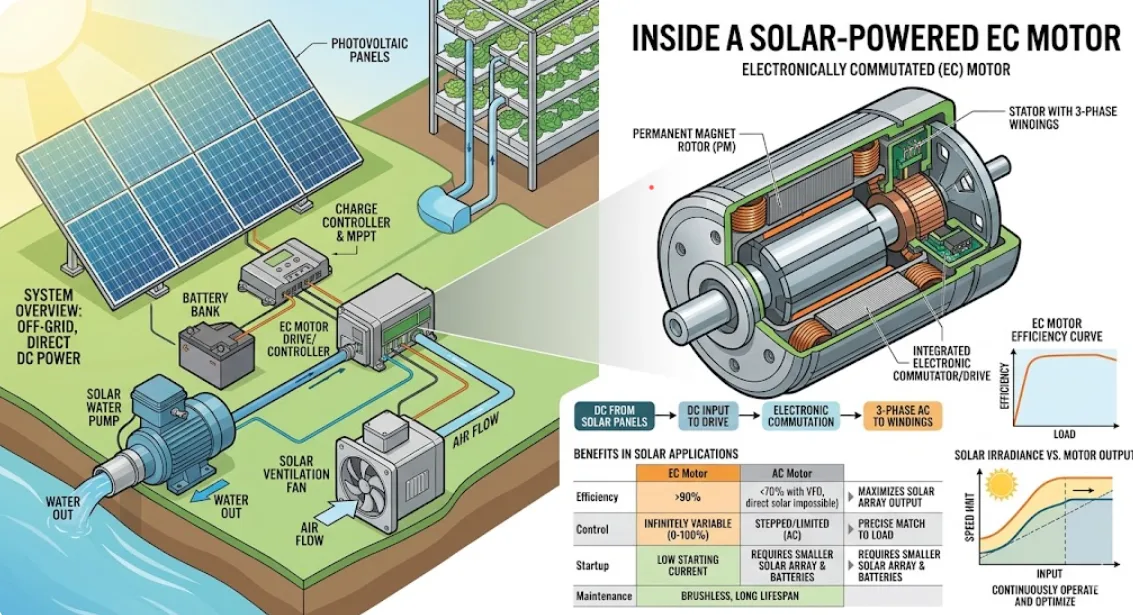
A solar-powered EC (Electronically Commutated) motor is a brushless DC motor that utilizes integrated electronics to control speed and torque, powered directly or indirectly by photovoltaic (PV) energy. These motors combine the high efficiency of permanent magnet brushless technology with the cost-neutrality of solar power, eliminating the conversion losses typically found in AC-to-DC transitions. According to the International Energy Agency (IEA), wholesale electricity prices in major markets remained elevated through 2025, making on-site solar generation a critical hedge against utility inflation.
Comparative Efficiency: EC Motors vs. Traditional AC Motors
Traditional AC induction motors often operate at 70-80% efficiency, whereas EC motors consistently exceed 90% efficiency across their entire speed range. When coupled with solar energy, the operational cost of these motors can drop to near zero during peak sunlight hours. This is particularly relevant for high-demand equipment such as a solar air cooler or industrial ventilation fans, which often peak when solar irradiance is highest.
| Feature | AC Induction Motor | Standard EC Motor | Solar-Powered EC Motor |
|---|---|---|---|
| Energy Source | Grid (AC) | Grid (AC/DC) | PV + Grid Hybrid |
| Efficiency Rating | 70% – 80% | 90% – 94% | 92% – 96% |
| Operational Cost | High (Utility-dependent) | Moderate (Efficiency-saved) | Low to Zero (Solar-offset) |
| Carbon Footprint | Significant | Reduced | Minimal |
Direct Electricity Cost Savings
The primary driver for switching to solar-powered EC motors is the reduction in “Peak Demand” charges. Most commercial utility contracts penalize businesses for high energy usage during the afternoon; however, solar-powered systems naturally produce the most energy during these periods. By using a solar industrial fan powered by an EC motor, a facility can bypass expensive daytime grid rates entirely. Industry estimates suggest that switching from AC to solar-EC systems can reduce motor-related energy expenditure by 40% to 65% depending on the region’s solar transition.
Long-Term ROI and Payback Periods
While the initial investment in solar-ready motor technology is higher than traditional alternatives, the simple payback period has shortened significantly. Enhanced government incentives and the decreasing cost of PV modules have brought the average ROI for industrial solar motor upgrades to within 2.5 to 4 years. For critical infrastructure like a solar pump used in agricultural or industrial water management, the elimination of fuel or grid-extension costs provides immediate cash flow benefits.
Maintenance and Lifecycle Advantages
EC motors lack carbon brushes, which are the primary failure point in traditional DC motors. This “brushless” design, paired with the stable power delivery of intelligent microgrids, extends the mechanical lifespan of the equipment. Modern systems, such as a solar air compressor, utilize smart controllers to prevent voltage spikes, further reducing the need for emergency repairs and production downtime.
Technical Integration and Microgrids
Effective savings are realized through “Photoelectric Complementarity,” a system where the motor intelligently switches between solar and grid power. This ensures that the air circulation system fan maintains constant RPM even when cloud cover reduces PV output. According to Deloitte’s 2026 Renewable Energy Outlook, the integration of solar and storage is now the standard for 80% of new industrial energy projects to ensure grid resilience.

Investment Checklist for Commercial Solar Motors
Before upgrading, facility managers should conduct a site-specific audit to maximize the savings potential of their motor fleet.
- Load Profile Analysis: Identify motors that operate primarily during daylight hours.
- Harmonic Distortion Check: Ensure the motor controllers minimize noise on the local microgrid.
- Solar Irradiance Mapping: Calculate the PV potential of the facility rooftop or adjacent land.
- Incentive Audit: Verify local tax credits for high-efficiency motor retrofits and renewable energy.
Summary of Economic Benefits
The transition to solar-powered EC motors is no longer just an environmental choice but a strategic financial necessity. The combination of 90%+ mechanical efficiency and zero-marginal-cost solar fuel creates a compelling business case. Data from the IEA Electricity 2026 report indicates that industrial demand is rising faster than grid capacity, making self-generation the only reliable way to stabilize long-term operational budgets.
Frequently Asked Questions
What is the average energy saving when switching to solar EC motors?
Most industrial applications see a 30% reduction in energy consumption from the EC motor’s efficiency alone, plus an additional 50-70% reduction in grid reliance when integrated with a properly sized PV array. Total operational savings frequently exceed 80% during peak sunlight months.
Can solar-powered EC motors operate during the night?
Yes, these systems typically utilize a hybrid power controller or an intelligent microgrid. When solar levels drop, the system seamlessly transitions to grid power or battery storage, ensuring that critical equipment like air circulation fans continue to operate without interruption or performance loss.
Are there specific industries that benefit most from this technology?
Industries with high cooling and ventilation needs—such as cold storage, agriculture, and large-scale manufacturing—see the fastest ROI. These sectors often require maximum motor output during the hottest parts of the day, which perfectly aligns with peak solar energy production cycles.
How does the lifespan of a solar EC motor compare to an AC motor?
EC motors generally last 20-30% longer than traditional AC induction motors because they run cooler and lack wearing parts like brushes. The electronics are also designed to handle the variable nature of DC power, providing better protection against power surges.
What is the typical payback period for a solar-powered motor upgrade?
For most commercial installations, the simple payback period ranges from 24 to 48 months. This timeline is influenced by local electricity rates, available renewable energy subsidies, and the total annual operating hours of the specific motor being replaced.