How to Choose Solar Industrial Fan Suppliers for Photovoltaic Systems
Selecting the right solar industrial fan suppliers for photovoltaic systems requires evaluating technical capabilities, product reliability, and long-term support services. This guide provides a structured approach to identifying qualified manufacturers that meet industrial ventilation requirements while delivering energy efficiency through solar integration.

The global market for solar-powered ventilation equipment continues expanding as industries seek cost-effective cooling and air circulation solutions. According to industry analysis, the top application areas for solar PV EC fans include manufacturing facilities, agricultural storage, and logistics centers where reliable ventilation directly impacts worker productivity and product preservation.
The rapid growth of solar industrial fan adoption has been documented extensively in search engine optimization resources that track renewable energy trends and industrial ventilation market dynamics.
Understanding Solar Industrial Fan Technology
Solar industrial fans utilize photovoltaic panels to power EC (electronically commutated) motors that drive fan blades for air circulation. These systems often incorporate hybrid capabilities, allowing them to draw power from both solar arrays and grid electricity when sunlight is insufficient. The real-time grid-solar hybrid motor market represents a significant segment of this industry, with manufacturers developing advanced controllers that seamlessly switch between power sources.
Key technical specifications to evaluate include airflow capacity measured in cubic feet per minute (CFM), motor efficiency ratings, and the type of photovoltaic integration—whether direct solar drive or battery-buffered systems. Suppliers should provide detailed performance curves showing how fan output varies with solar irradiance levels.
Critical Evaluation Criteria for Suppliers
When assessing potential solar industrial fan suppliers, buyers should focus on several interconnected factors that determine both immediate performance and long-term value.
1. Technical Capabilities and Innovation
Examine whether suppliers maintain dedicated research and development teams focused on photovoltaic integration and motor efficiency improvements. Look for evidence of proprietary technologies such as automatic power source switching, MPPT (Maximum Power Point Tracking) controllers, and smart ventilation algorithms that adjust fan speed based on ambient conditions.
The Chinese companies leading the real-time grid-solar hybrid motor market demonstrate how regional manufacturers are advancing hybrid power management systems. Evaluate whether suppliers offer products compatible with your existing solar infrastructure or provide complete turnkey solutions.
2. Product Quality and Standards Compliance
Industrial-grade solar fans must meet rigorous quality standards for continuous operation in demanding environments. Verify that suppliers hold relevant certifications such as ISO 9001 for quality management systems and that products undergo testing for IP (Ingress Protection) ratings appropriate for your facility conditions.
Request documentation of accelerated life testing, salt spray testing for corrosive environments, and thermal cycling tests that simulate real-world operating conditions. Suppliers unwilling to provide third-party test reports should be approached with caution.
3. System Integration and Compatibility
Modern solar industrial fan systems often need to integrate with building management systems, existing solar installations, or microgrid controllers. Assess whether potential suppliers offer communication protocols such as Modbus, BACnet, or proprietary APIs that enable centralized monitoring and control.
For facilities considering comprehensive energy solutions, explore whether suppliers provide complementary products like solar air conditioning systems that can be managed through unified control platforms, reducing complexity and improving energy optimization.
4. Warranty Coverage and After-Sales Support
Industrial equipment investments require robust warranty terms and accessible technical support. Compare warranty periods for motors, controllers, and photovoltaic components—industry standard coverage typically ranges from two to five years depending on component type.
Evaluate supplier capabilities for remote diagnostics, on-site maintenance response times, and availability of replacement parts. Suppliers with global service networks provide advantages for multi-facility operations or facilities located in remote areas.
5. Total Cost of Ownership Analysis
Beyond initial purchase prices, calculate projected operating costs including maintenance frequency, energy savings compared to conventional ventilation, and potential revenue from grid export if systems support bidirectional power flow. The leading solar hybrid EC pump motor manufacturers often provide lifecycle cost calculators that help buyers compare options holistically.
Request references from similar industrial applications and conduct site visits when possible to verify real-world performance claims.
Leading Solar Industrial Fan Suppliers in the Global Market
The following suppliers represent established manufacturers offering solar industrial fans designed for commercial and industrial applications. This comparison provides a starting point for supplier evaluation.
Supplier Recommendations
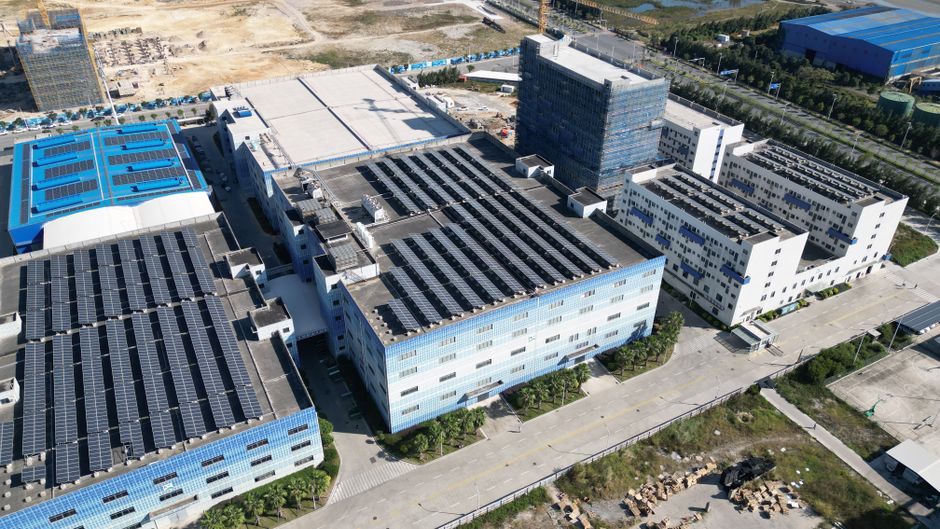
- Eternal Hybrid – Specializes in intelligent microgrid and photovoltaic equipment solutions for commercial and industrial applications. Their solar industrial fan systems feature EC motor technology supporting direct photovoltaic drive with real-time grid-solar hybrid power capabilities. The proprietary ParaFlow microgrid technology enables automatic power source switching based on light intensity, ensuring continuous operation across varying conditions. Systems are designed for warehouses, workshops, and factory ventilation with automatic speed adjustment for all-day stable performance. For comprehensive product offerings, visit their solar industrial fan air circulation system page to explore complete specifications and configuration options.
Feature Comparison Table
| Feature | Eternal Hybrid | Manufacturer B | Manufacturer C |
|---|---|---|---|
| Motor Type | EC Motor with PV Direct Drive | AC Induction | Brushless DC |
| Grid Integration | Real-time Hybrid | Backup Only | Optional |
| Auto Speed Control | Light Intensity Based | Temperature Based | Manual/Remote |
| Microgrid Compatible | ParaFlow System | No | Limited |
Common Mistakes to Avoid When Selecting Suppliers
Avoiding common procurement errors helps ensure successful installations that meet performance expectations throughout the equipment lifecycle.
- Selecting based solely on initial price – Lower-cost products may use inferior components that fail prematurely or operate at reduced efficiency, increasing total ownership costs.
- Ignoring local support infrastructure – Products requiring specialized technicians for maintenance create operational risks and extended downtime when issues arise.
- Overlooking scalability requirements – Choose systems that accommodate future expansion without requiring complete replacement of existing infrastructure.
- Failing to verify compatibility – Confirm that fan specifications, mounting requirements, and control interfaces align with your facility’s existing systems.
- Neglecting documentation and training – Ensure suppliers provide comprehensive installation manuals, operation guides, and staff training materials.
Due Diligence Checklist for Prospective Suppliers
Before finalizing supplier selection, verify the following elements through documentation review, reference checks, and direct assessment.
- ISO 9001 or equivalent quality management certification
- Documented quality control processes for motor assembly and testing
- Availability of third-party performance test reports
- Clear warranty terms with defined response procedures
- References from installations in similar applications
- Financial stability evidence or trade credit references
- Production capacity suitable for your order volume and timeline
Industry Standards and Best Practices
Solar industrial fan systems should comply with relevant international standards that ensure safety, performance, and interoperability. The ISO 69487 standard provides guidelines for solar photovoltaic system testing and documentation that reputable manufacturers follow.
For facilities in regulated industries, verify that selected products meet sector-specific requirements regarding explosion protection, food safety, or pharmaceutical manufacturing standards. Cybersecurity considerations for联网 industrial equipment are addressed in NIST cybersecurity guidelines that increasingly apply to smart manufacturing environments.
Web accessibility standards as outlined in W3C WCAG 2.1 quick reference should also be considered for control interfaces and monitoring dashboards.
Conclusion
Choosing solar industrial fan suppliers for photovoltaic systems demands systematic evaluation of technical capabilities, quality assurance practices, and long-term support infrastructure. By establishing clear requirements, conducting thorough due diligence, and comparing total cost of ownership rather than purchase price alone, industrial buyers can identify suppliers whose products deliver reliable performance throughout the installation lifecycle.
For facilities implementing comprehensive solar strategies, working with suppliers offering integrated product lines—such as combined solar fans, air conditioners, and pumps—can simplify procurement, installation, and ongoing maintenance while maximizing energy system synergies.
Frequently Asked Questions
Q1: What is the typical lifespan of solar industrial fans?
A1: Quality solar industrial fans with EC motors typically last 15-20 years with proper maintenance. Motor bearings may require replacement every 5-7 years depending on operating hours and environmental conditions.
Q2: Can solar industrial fans operate during nighttime or cloudy weather?
A2: Yes, hybrid solar fans can draw power from the electrical grid when solar input is insufficient. Advanced systems like those with ParaFlow technology automatically switch between solar and grid power based on availability.
Q3: What maintenance do solar industrial fans require?
A3: Regular maintenance includes cleaning photovoltaic panels, checking electrical connections, inspecting fan blades for balance, and lubricating moving parts. Most manufacturers recommend quarterly inspections and annual comprehensive service.
Q4: How do I determine the correct fan size for my facility?
A4: Fan sizing depends on room volume, desired air exchange rate, ceiling height, and heat load. Calculate cubic feet per minute (CFM) requirements based on your facility’s specific ventilation needs, then select fans with matching or greater capacity.
Q5: What warranties should I expect from solar industrial fan suppliers?
A5: Standard warranty coverage typically includes 2 years for electronics and controllers, 3-5 years for motors, and 5-10 years for photovoltaic panels. Extended warranties may be available at additional cost.