Brushless DC (BLDC) motors have become the primary technological benchmark for modern water extraction due to superior operational efficiency and thermal management. This comprehensive industrial guide analyzes why high-performance BLDC solar water pump motors optimize renewable infrastructure, lower total cost of ownership, and outpace traditional alternating current alternatives. Integrating an advanced irrigation layout with reliable equipment ensures long-term agricultural sustainability and decentralized water security across global jurisdictions.
The Mechanical Evolution of Brushless DC Solar Water Pump Systems
Mechanical transitions in agricultural engineering heavily favor technical components that eliminate friction-induced power reduction. Traditional alternating current induction mechanisms require multiple power inversion stages, which inherently diminish the net power output generated by photovoltaic arrays. Modern agricultural layouts resolve this system friction by deploying direct-powered brushless DC motor pumps that connect directly to photovoltaic electrical architectures. By executing electronic commutation via internal sensors, these specialized pumping units completely remove carbon brushes, which eliminates recurring mechanical friction, electrical sparking risks, and rotor power losses.
According to comprehensive field evaluations published in the Journal of Renewable Energies, direct-drive brushless architectures maintain operational stability under variable voltage inputs. Electronic controllers dynamically adjust the stator magnetic fields to match incoming direct current power, mitigating the typical startup torque failures common in standard single-phase induction machinery. This optimized electrical conversion curve guarantees that fluid transportation begins earlier during low-light morning hours and continues later into the evening sequence.
Key Technical Metric (Empirical Standard): Comparative engineering data demonstrates that a brushless DC installation minimizes electrical losses by up to 40% compared to equivalent asynchronous alternatives, achieving peak mechanical conversion benchmarks under severe thermal stress.
Quantifying the Efficiency Framework of Premium Solar Submersible Pumps
Fluid dynamics and energy optimization require continuous monitoring of motor power consumption variables relative to total volumetric output. High-efficiency solar submersible pumps exploit rare-earth permanent magnets within the rotor structure to generate continuous magnetic flux without drawing external electrical current for rotor magnetization. This design aspect classifies these units under the premium IE5 efficiency standard framework established by the International Electrotechnical Commission (IEC). Standard alternating current motors lose substantial thermal energy through copper windings, whereas brushless topologies operate significantly cooler, preserving insulation integrity over extended duty cycles.
Dynamic monitoring proves that partial-load performance represents the most critical metric for decentralized fluid management grids. Photovoltaic power generation fluctuates continuously due to cloud attenuation, atmospheric particulate scattering, and shifting solar incidence angles. While conventional alternating current motors drop significantly in operational efficiency when power levels fall below 70% of rated capacity, permanent magnet architectures maintain highly linear efficiency performance across their entire operating envelope.
The operational difference becomes evident when evaluating complete power drive systems over an annualized agricultural irrigation cycle. Technical validation protocols conducted by the International Electrotechnical Commission (IEC) verify that IE5-compliant brushless architectures lower internal electrical losses by 20% to 30% compared to standard IE3 induction systems. This structural optimization ensures maximum volumetric output per peak watt of installed photovoltaic capacity, directly lowering the capital requirements for heavy solar panel mounting frameworks.
Table 1: Comparative Analysis of Pumping Motor Technologies
| Performance Variable | BLDC Permanent Magnet Motor | AC Induction Motor (Standard) | DC Brushed Motor (Legacy) |
|---|---|---|---|
| Peak Motor Efficiency | 88% – 95% (IE5 Standard Class) | 72% – 82% (IE2/IE3 Class) | 65% – 75% (Sub-standard) |
| Maintenance Interval | Exceeds 30,000 Operating Hours | 15,000 Operating Hours (Bearings) | 2,000 Hours (Brush Replacement) |
| Low-Light Threshold | Highly Operational at <300 W/m² | Requires >500 W/m² Inverter Threshold | Moderate Operational Capacity |
| Thermal Energy Loss | Minimal (No Rotor Current Loss) | High (Stator & Rotor Heat Loss) | Severe (Friction & Commutator Heat) |
| System Complexity | Low (Direct Photovoltaic Integration) | High (Requires Variable Frequency Inverter) | Low (Direct Drive, High Wear) |
Operational Advantages of Advanced Solar Surface Pumps in Agriculture
Shallow fluid extraction applications, livestock watering installations, and localized open-canopy irrigation setups require adaptable surface-mounted machinery. Industrial-grade solar surface pumps utilizing integrated brushless drivetrains deliver high volumetric discharge rates while consuming minimal initial starting current. Traditional alternating current centrifugal mechanisms often require up to three times their operational running current to initiate rotor movement from a static position. This low starting current characteristic means growers do not need to over-size their photovoltaic arrays just to handle brief starting torque loads.
Reliable operations also depend heavily on advanced algorithms embedded within the control software of the motor drive unit. Modern irrigation systems utilize Maximum Power Point Tracking (MPPT) microcontrollers to monitor real-time photovoltaic output parameters continuously. The motor controller dynamically alters its operational frequency to match the precise maximum power coordinates of the solar array, converting voltage fluctuations into stable shaft rotation. Field data from global research installations confirms that adding intelligent MPPT tracking boosts daily fluid yields by up to 30% compared to fixed-voltage pumping configurations.
System Optimization Rule: Deploying integrated MPPT electronics within a brushless DC infrastructure enables efficient fluid transport under adverse weather conditions, ensuring continuous livestock watering even when solar irradiance drops below 400 Watts per square meter.
Thermal Management and Longevity of Specialized Solar Pool Pumps
Continuous filtration loops, commercial water features, and residential sanitation layouts place unique long-term operational demands on electrical motor designs. High-utilization solar pool pumps engineered with brushless architectures exhibit superior thermal performance compared to typical induction models. Because the stator contains the only copper windings generating heat, thermal dissipation is achieved easily through external cooling fins or surrounding fluid jackets. Lower internal operating temperatures prevent bearing grease degradation and protect stator insulation from thermal breakdown, extending the product lifespan to more than 30,000 continuous hours.
Eliminating physical mechanical contact components also improves structural reliability when equipment is deployed in harsh, high-salinity coastal areas. Physical contact brushes in legacy direct current motors create conductive carbon dust, which eventually causes internal short circuits and winding failure. Brushless configurations seal all sensitive control electronics within ingress-protected IP68 or IP65 modular chambers, protecting internal parts from ambient humidity, chemical vapor infiltration, and abrasive dust particles.
Financial Architecture and ROI of High-Performance Solar Pumping Inverters
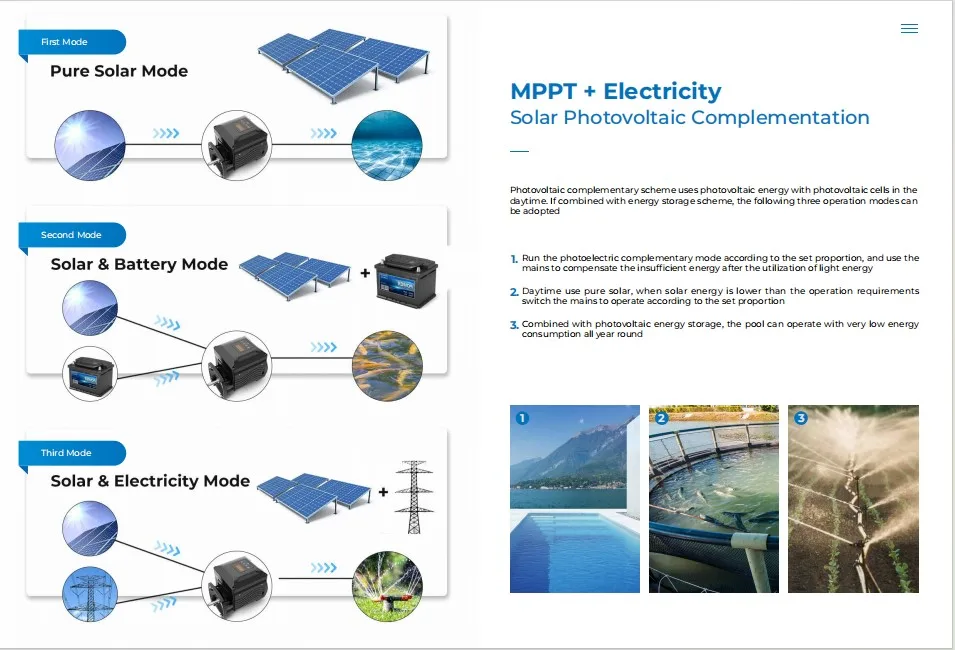
Evaluating long-term agricultural investments requires analyzing both initial capital expenses and ongoing lifetime operational costs. While advanced brushless pumping arrays carry a higher upfront acquisition cost than legacy diesel assemblies, their long-term operating costs are virtually zero. Specialized solar pumping inverters and dual-mode brushless controllers allow systems to transition between daytime photovoltaic power and backup grid networks or battery banks. This multi-source flexibility protects valuable agricultural crops from severe drought risks during prolonged periods of overcast weather or unexpected grid failures.
Market intelligence evaluations indicate rapid global expansion within the agricultural machinery sector. According to market data published by The National Renewable Energy Laboratory (NREL), the international solar pumping framework is projected to surpass a valuation of $1.5 billion by the year 2026. This market expansion highlights a global industrial shift away from fossil-fuel-powered machinery toward highly sustainable, electronically commutated fluid transportation infrastructure.
Economic Capital Impact (According to Industry Estimates): According to industry estimates, converting a diesel-powered water extraction system to an automated brushless DC solar assembly saves over $1,500 annually in fuel costs, delivering full capital amortization within 14 to 18 months of continuous use.
Engineering Selection Protocol for Decentralized Fluid Extraction Networks
Selecting the proper equipment configuration requires calculating exact hydraulic lift demands alongside local meteorological solar irradiance averages. System designers must precisely match the maximum total dynamic head (TDH) parameters against the performance curve of the selected pumping mechanism. Selecting an oversized motor causes unnecessary capital expenditure on oversized solar arrays, while under-sizing components leads to insufficient volumetric output during peak irrigation windows.
- Calculate Total Dynamic Head (TDH): Add the vertical lift distance to the frictional pipe losses measured across the full fluid transport layout.
- Assess Local Solar Irradiance: Identify local peak sun hours using meteorological databases to establish realistic minimum and maximum daily wattage generation profiles.
- Map Performance Curves: Match the calculated fluid volume requirements with the optimal motor efficiency range shown on manufacturer performance charts.
- Verify Electrical Thresholds: Confirm that the maximum open-circuit voltage of the solar array does not exceed the upper input threshold of the brushless controller.
- Integrate Safety Sensors: Install integrated dry-run protection sensors to protect internal subroutines from running without sufficient fluid lubrication.
Frequently Asked Questions Regarding BLDC Solar Pumping Infrastructure
1. How do brushless DC motors maintain operation during low-light conditions?
Brushless DC motors leverage high-coercivity internal permanent magnets that require zero initialization current for rotor magnetization. Integrated MPPT controllers continuously scale operational frequencies downward, enabling the pump to execute fluid displacement under low solar irradiance parameters where standard AC induction motors stall due to torque deficits.
2. What specific maintenance procedures are required for brushless solar pumping infrastructure?
Because brushless motors eliminate carbon brushes, mechanical maintenance is restricted to semi-annual cleanings of the photovoltaic panels and physical inspection of the intake seals. Internal electrical components remain hermetically sealed within IP68 housings, preventing environmental dust or fluid ingress from degrading the internal stator windings.
3. Can a brushless DC solar motor execute fluid transport directly without an inverter?
Yes, specialized brushless DC pumping assemblies are designed to operate directly from the direct current output generated by solar panels. This direct-drive architecture eliminates the need for expensive external alternating current inverters, simplifying the wiring layout and removing a common point of electrical component failure.
4. Why do permanent magnet BLDC motors achieve superior thermal metrics over induction models?
Permanent magnet architectures eliminate rotor copper losses because the magnetic field is permanently present without requiring electrical energy input. Consequently, internal thermal dissipation is concentrated solely within the external stator, keeping operating temperatures low and preventing the premature thermal breakdown of internal bearing lubricants.
5. What is the expected operational lifespan of an industrial brushless solar pump?
An industrial-grade brushless motor typically exceeds an operational lifespan of 30,000 hours under standard duty cycles due to its frictionless operation. This corresponds to more than ten years of reliable agricultural irrigation performance, outlasting traditional brushed motors by a factor of fifteen.