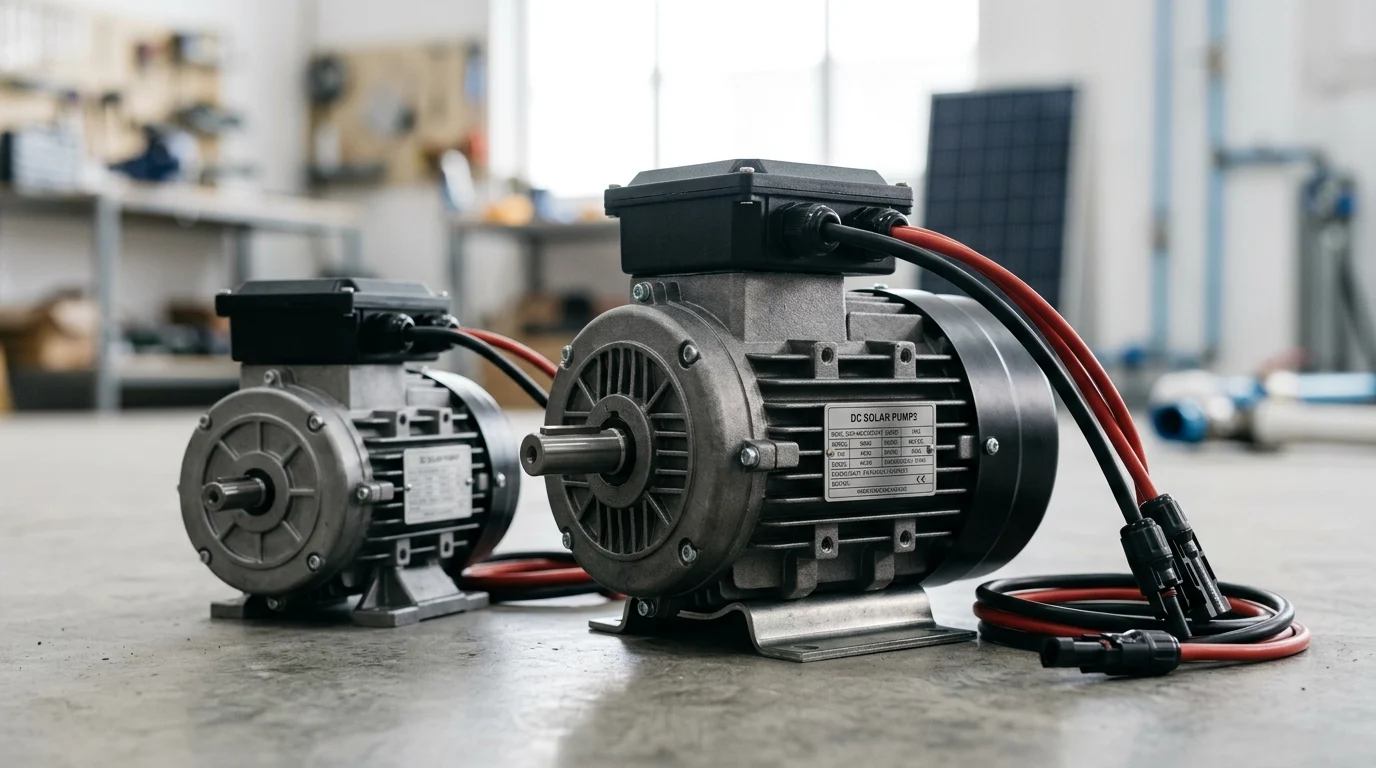
Introduction
Reliable water delivery in off-grid locations depends as much on power choice as on pump design. DC solar pump motors are increasingly used in remote water supply projects because they reduce fuel dependence, simplify maintenance, and offer predictable long-term operating costs where diesel logistics and weak grids create risk. This article explains how these motors work in practical terms, why they are often the most economical option over a full project lifecycle, and which applications benefit most, from deep-well extraction to community and agricultural supply. It also sets up the key factors to evaluate before selecting a system, including site conditions, duty requirements, and expected performance.
Why DC Solar Pump Motors Are a Strategic Choice
Securing reliable water infrastructure in off-grid environments requires robust technological solutions. DC solar pump motors have emerged as the primary mechanism for remote fluid transport, replacing legacy fossil-fuel systems through superior operational economics and mechanical reliability.
Diesel volatility, grid unreliability, and lifecycle cost
The volatility of global diesel prices, frequently fluctuating between $1.50 and $2.50 per liter in remote regions due to complex transport logistics, renders internal combustion pumps financially burdensome. When factored over a standard 10-year operational lifecycle, the cumulative fuel and routine maintenance costs of diesel systems far exceed their initial capital expenditure.
Conversely, DC solar pump motors operate with near-zero variable costs. Financial modeling for remote agricultural installations typically demonstrates a return on investment (ROI) or payback period of 18 to 36 months, after which water extraction is effectively free of energy costs. Furthermore, the elimination of fuel supply chain dependencies drastically increases the uptime of critical water systems in isolated geographies.
Best-fit applications and use cases
These motors are engineered for environments where grid extension is economically unviable, typically costing upwards of $20,000 per kilometer. Primary applications include large-scale agricultural irrigation, deep-well livestock watering, and municipal water supply for remote communities.
Modern DC solar pump motors are capable of servicing deep boreholes with a Total Dynamic Head (TDH) exceeding 250 meters, making them highly versatile for both shallow surface water transfer and deep aquifer extraction. Their ability to operate autonomously makes them the standard for decentralized water management.
Key Technical Specifications and Performance Metrics

The mechanical and electrical architecture of DC solar pump motors dictates their efficiency and suitability for specific hydrological profiles. Understanding these technical baselines is essential for proper procurement and deployment.
Motor, pump, and controller basics
At the core of high-performance systems is the Brushless DC (BLDC) motor. Unlike traditional brushed motors, BLDC units utilize electronic commutation, eliminating brush wear and significantly extending the operational lifespan. These motors typically achieve electrical efficiencies between 85% and 92%, directly translating to higher water yields per watt of solar energy harvested. They operate in tandem with Maximum Power Point Tracking (MPPT) controllers, which dynamically adjust the electrical load to match the fluctuating current and voltage from the solar array, ensuring optimal torque even during low-irradiance conditions.
Core performance specifications
Critical performance specifications revolve around the interplay between flow rate (measured in cubic meters per hour, or m³/h) and Total Dynamic Head (TDH). Commercially viable DC solar pump motors operate across a wide voltage spectrum, typically ranging from 24V for shallow, low-volume applications to 300V or more for deep-well, high-yield requirements. Submersible units must also maintain strict hermetic sealing, often utilizing water-filled or oil-filled encapsulation to manage thermal dissipation while submerged at depths up to 300 meters.
Comparison factors for evaluating options
When evaluating technological options, project engineers must weigh the immediate benefits of DC systems against traditional AC alternatives operating via inverters. Understanding the trade-offs in efficiency and complexity is critical for optimizing system design.
| Specification | BLDC Solar Pump Motor | Traditional AC Pump (with Inverter) |
|---|---|---|
| Motor Efficiency | 85% – 92% | 70% – 80% |
| Starting Torque | High (ideal for low sunlight) | Moderate (requires high inrush current) |
| Maintenance | Minimal (no brushes) | Higher (inverter and motor wear) |
| Optimal TDH Range | 10m – 250m | 50m – 400m+ |
| System Complexity | Low (direct MPPT integration) | High (requires VFD/Inverter) |
How to Evaluate DC Solar Pump Motors for a Project
Proper evaluation and site-specific engineering are critical to maximizing the lifespan and output of DC solar pump motors. Systemic failures in remote locations are disproportionately expensive to rectify, necessitating rigorous upfront analysis.
System sizing and solar matching process
The sizing of the photovoltaic (PV) array relative to the motor is the most critical design parameter. Industry best practices dictate oversizing the solar array by a factor of 1.3x to 1.5x the motor’s rated power. For instance, a 1,000W DC solar pump motor requires a PV array of at least 1,300W to 1,500W to ensure adequate performance during early morning, late afternoon, and overcast conditions.
Engineers must calculate the daily water requirement against the site’s average Peak Sun Hours (PSH), integrating dynamic head calculations that account for both static water levels and seasonal drawdown variations. Accurately plotting the pump curve against the solar availability ensures the system meets volumetric targets without continuous battery reliance.
Common failure modes and site risks
Despite their robust design, DC solar pump motors remain susceptible to specific environmental and operational hazards. Dry running is a primary failure mode; without water to provide lubrication and cooling, the stator windings can overheat and degrade within minutes. Consequently, advanced controllers integrate low-water sensor inputs or sensorless current-monitoring algorithms to halt operation automatically.
Sand ingress is another critical risk in borehole applications. Standard submersible pumps are typically rated for a maximum sand tolerance of 50 grams per cubic meter (50 ppm). Exceeding this threshold accelerates the degradation of impellers and motor bearings, necessitating the selection of specialized helical rotor pumps or multi-stage centrifugal pumps with high-abrasion resistance for sandy aquifers.
Sourcing, Compliance, and Procurement Factors
Procuring DC solar pump motors at scale requires navigating a complex global supply chain, balancing unit costs against long-term reliability and regulatory compliance.
Supplier capability and quality control
Supplier capability extends beyond basic assembly. Top-tier manufacturers utilize high-grade Neodymium (NdFeB) magnets for BLDC motors and employ automated stator winding processes to ensure electromagnetic consistency. Buyers should audit factories for rigorous end-of-line testing, including pressure vessel simulations and prolonged submerged run-tests. A reliable OEM or tier-one supplier should demonstrate a defect rate strictly below 0.5% across production batches. Quality control protocols must also cover the MPPT controllers, ensuring they are potted with thermal epoxy to withstand harsh ambient temperatures.
Certifications and regional compliance
Compliance with international standards mitigates legal and operational risks. Submersible DC solar pump motors must carry a verified IP68 ingress protection rating. Electrical components should align with CE directives for electromagnetic compatibility (EMC) and low voltage, while the accompanying solar modules must meet IEC 61215 and IEC 61730 standards. For potable water projects, the materials in contact with the water—such as 304 or 316 stainless steel housings and food-grade lubricants—must comply with regional health standards like NSF/ANSI 61 in North America or WRAS in the United Kingdom.
Cost drivers, logistics, and lead times
Capital expenditure for these systems is distributed across several key components. Understanding this distribution aids in accurate budgeting and supplier negotiation.
| Component | Estimated % of Total System Cost | Key Cost Drivers |
|---|---|---|
| DC Motor & Pump End | 40% – 50% | Motor wattage, SS316 vs SS304, BLDC technology |
| MPPT Controller | 15% – 20% | Amperage rating, IP65+ enclosure, remote monitoring |
| Solar PV Array | 20% – 25% | Wattage, monocrystalline efficiency, mounting structure |
| Cables & Accessories | 10% – 15% | Copper prices, drop cable length, water level sensors |
Logistics and lead times also heavily influence procurement strategies. Standard manufacturing lead times for commercial orders typically range from 30 to 45 days, depending on the Minimum Order Quantity (MOQ), which frequently sits between 10 and 50 units for direct OEM purchasing. Ocean freight and customs clearance can add an additional 4 to 6 weeks, requiring project managers to initiate procurement at least a fiscal quarter ahead of planned installation dates.
Investment Decision Criteria
Capital allocation for off-grid water infrastructure demands a stringent evaluation of technological suitability versus financial feasibility.
When DC Solar Pump Motors are the best choice
DC solar pump motors are unequivocally the optimal choice for installations where grid connectivity is absent and daily water demand aligns with daylight availability. They excel in scenarios requiring continuous, moderate flow rates rather than sudden, high-volume extractions. The technology reaches its maximum economic utility in regions with insolation rates exceeding 4.5 kWh/m²/day and where the TDH remains below the 250-meter threshold. Beyond these depths, the required DC voltage and motor sizing begin to yield diminishing economic returns compared to high-voltage AC systems driven by large solar inverters.
Decision framework for buyers and project teams
Project teams should utilize a Total Cost of Ownership (TCO) framework spanning a 10 to 15-year horizon to evaluate these systems. This framework must calculate initial CAPEX, projected maintenance reductions (often up to 70% lower than internal combustion alternatives), and the complete elimination of fuel logistics. By standardizing procurement around high-efficiency BLDC motors, rigorously sizing the PV array to 1.5x the motor load, and enforcing strict IP68 and material certifications during sourcing, stakeholders can guarantee resilient, maintenance-free water delivery in the most demanding remote environments.
Key Takeaways
- The most important conclusions and rationale for DC Solar Pump Motors
- Specs, compliance, and risk checks worth validating before you commit
- Practical next steps and caveats readers can apply immediately
Frequently Asked Questions
Why choose a DC solar pump motor for remote water supply projects?
It cuts diesel fuel and maintenance costs, improves uptime in off-grid areas, and often reaches payback in 18–36 months for agricultural or community water systems.
What pump head and depth can DC solar pump motors handle?
Many commercial BLDC systems support about 10–250m TDH, with some submersible designs working in boreholes up to 300m when properly matched to the pump and controller.
How do I size a DC solar pump motor correctly?
Start with required daily water volume, total dynamic head, site solar irradiance, and operating hours. Then match the motor voltage, pump curve, MPPT controller, and PV array to those conditions.
Are BLDC solar pump motors better than AC pumps with inverters?
For many remote projects, yes. BLDC motors are typically more efficient, have high starting torque in low sunlight, and avoid extra inverter complexity, which helps reliability and reduces maintenance.
Can Eternal Energy integrate day and night pumping support?
Yes. Eternal Energy’s intelligent photovoltaic microgrid solutions, including ParaFlow MicroGrid, can support solar water pumping with photoelectric complementary power for more stable operation beyond peak sun hours.